Apple Just Killed Vibe Coding on the App Store — While Shipping Its Own
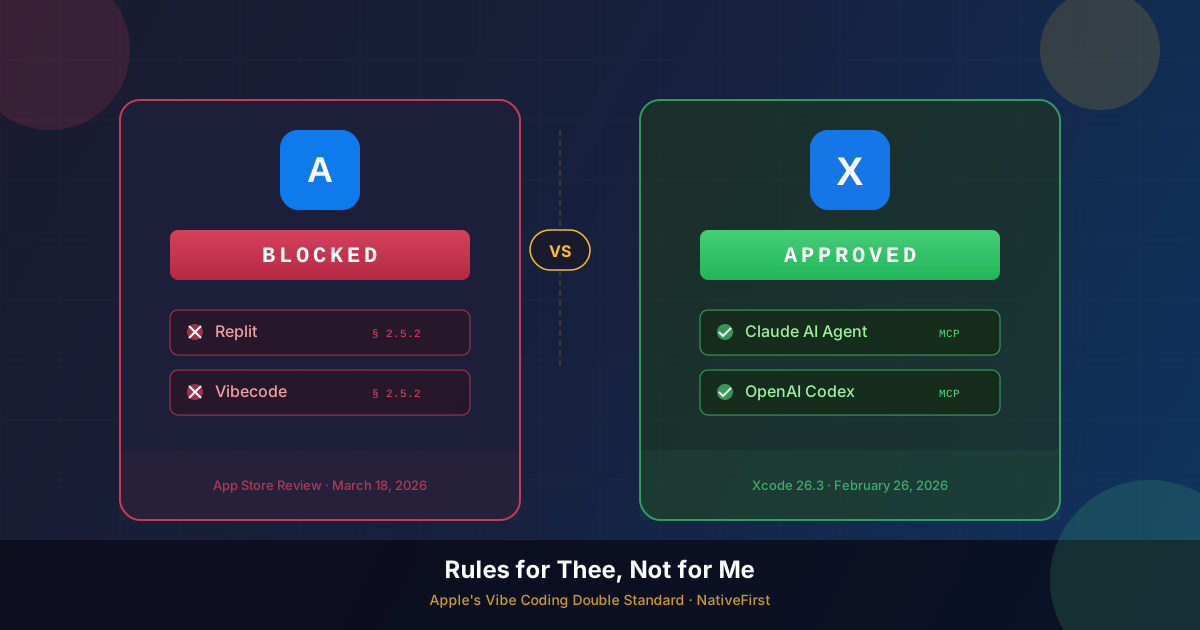
Last Tuesday, Apple blocked App Store updates for Replit and Vibecode. The reason? Guideline 2.5.2 — apps can’t download or execute code that changes their functionality after review. Fair enough. Rules are rules.
Then, six days earlier, Apple shipped Xcode 26.3 with built-in AI coding agents powered by OpenAI Codex and Anthropic Claude. Literally AI that writes your code for you. Inside Apple’s own IDE.
I read both announcements on the same morning. Spilled my coffee. Not because of the news — because of the audacity.
The Timeline That Tells the Story
Let me lay this out because the timing is almost comedic.
February 26, 2026: Apple releases Xcode 26.3. The headliner? AI coding agents via MCP (Model Context Protocol). You can connect Claude, Codex, or any MCP-compatible model directly to Xcode. It writes Swift for you. It debugs for you. Apple’s own marketing shows a developer saying “build me a photo gallery with Core Data” and watching the code appear. This is vibe coding. Apple just didn’t call it that.
March 18, 2026: Apple blocks updates for Replit and Vibecode on the App Store. The stated reason: these apps let users build and run code on-device, which could change an app’s behavior post-review. MacRumors confirmed the block. Both apps are in limbo.
So in the span of three weeks, Apple said: “AI coding inside our tools? Beautiful. Innovation. The future. AI coding inside your tools? Violation. Blocked. Next.”
This is like a restaurant banning food delivery apps while simultaneously launching their own delivery service. Same food. Same customers. Different logo.
Why Apple Did It (The Charitable Version)
Look, I’m not going to pretend this is pure evil. There’s a real problem Apple is responding to, even if their response is… selectively applied.
The App Store has been drowning in vibe-coded garbage. Since vibe coding tools went mainstream in late 2025, the volume of app submissions has exploded. Not the quality — the volume. How-To Geek published a piece literally titled “Please Stop Paying for Vibe Coded Apps” and it resonated because everyone felt it.
Here’s what the flood looks like in practice:
- Apps with plaintext password storage (in 2026!)
- Exposed API keys hardcoded into the client
- Authentication flows that look correct but bypass actual verification
- UI that passes the screenshot test but crashes on any edge case
The Lovable security analysis was the real wake-up call. 10.3% of Lovable-generated apps had critical row-level security flaws in Supabase — handling real user data with exploitable access control gaps. These aren’t theoretical vulnerabilities. These are apps on the store, right now, with people’s data in them.

A CodeRabbit analysis of 470 GitHub PRs found that AI co-authored code contains 1.7x more major issues and 2.74x more security vulnerabilities than human-written code. Stack Overflow ran a piece called “AI Can 10x Developers… In Creating Tech Debt” and it became a rallying cry.
So yeah. Apple looked at this flood, looked at the security reports, looked at the review queue getting slower, and pulled the lever. I get it.
I just wish they’d pulled it on themselves too.
Why Apple Did It (The Real Version)
Here’s where it gets uncomfortable.
Apple doesn’t have a problem with AI-generated code. They have a problem with AI-generated code they don’t control. Xcode’s AI agents produce code that goes through the normal Xcode build process, gets compiled by Apple’s toolchain, and gets submitted through the normal review pipeline. Apple can see it. Apple can scan it. Apple can reject it.
Replit and Vibecode are different. They let you build apps on-device, modify behavior through interpreted code, and potentially change what an app does after Apple approved it. From Apple’s perspective, that’s a trojan horse. From a user’s perspective, that’s… also kind of a trojan horse. But the principle matters.
Guideline 2.5.2 isn’t new. It’s been there for years. It’s the same rule that killed various scripting apps and code interpreters in the past. Apple is applying an existing rule to new tools. The question is whether the rule still makes sense when Apple itself is shipping tools that blur the same lines.
It’s like a bouncer enforcing a “no sneakers” dress code while wearing Jordans. Technically, different rules for different roles. Practically? Come on.
The Internet Reacted Exactly How You’d Expect
Reddit exploded. Here are some highlights I collected over the past few days:
One developer on r/iOSProgramming wrote: “So Apple can put AI in Xcode but I can’t use Replit on my iPad to build the same app? Make it make sense.” 847 upvotes. Nobody made it make sense.
The r/vibecoding subreddit (89,000 members and growing) had a mega-thread titled “The problem with vibe coding is nobody wants to talk about maintenance” — 562 upvotes, 252 comments. The top comment: “I built a SaaS with zero hand-written code. Zero. Then someone bypassed my subscription check, maxed out my API keys, and corrupted my database. Turns out ‘zero hand-written code’ also meant ‘zero hand-written security.’”
That one stung because it’s not a hypothetical. It happened. And it’s the exact scenario Apple is trying to prevent. The guy who posted it wasn’t angry at Apple — he was angry at himself for shipping something he didn’t understand.
Meanwhile, Andrej Karpathy — the guy who coined “vibe coding” in the first place — declared in February that the term is already passé and proposed “agentic engineering” as the successor. The term he created less than a year ago is already embarrassing him. That’s the fastest nomenclature lifecycle in tech history.
The Part Nobody’s Talking About
Here’s what keeps me up at night, and it’s not the App Store drama.
63% of active vibe coding users aren’t developers. They’re founders, product managers, marketers, and people who had an idea and finally had a tool that could make it real. A Solveo analysis of 1,000 Reddit users confirmed this.
When Apple blocks vibe coding platforms, they’re not just blocking bad code. They’re blocking the single biggest democratization of app development since the App Store launched. The person who built “Crash Out Diary” — a journaling app made by a non-coder mom using Claude — that app exists because of vibe coding. “Dog-e-dex” — an iOS app that identifies dog breeds — same story.
These people aren’t going to learn Swift. They’re not going to open Xcode 26.3 and configure MCP servers. They’re going to go back to having ideas they can’t build.

And that brings us to the ugly number nobody in tech wants to acknowledge.
The Junior Developer Crisis Is Real, and This Makes It Worse
Entry-level tech roles in the US have dropped 67% since 2024. In the UK, it’s 46% and projected to hit 53% by year’s end. 37% of employers say they’d rather hire AI than a recent graduate. A Stanford study found that employment for 22-25 year olds in software has declined 6%, while it increased 9% for 35-49 year olds.
Read that again. The industry is simultaneously saying “we need experienced developers” and “we won’t hire anyone who could become one.”
This is the pipeline problem. Juniors need jobs to become seniors. Seniors need juniors to train and delegate to. If you break the first step, the second step collapses five years later. We wrote about this in our 2031 predictions post and the comments were… intense.
DEV Community published a piece called “The Junior Developer Crisis of 2026: AI Is Creating Developers Who Can’t Debug” and it hit a nerve. The argument: vibe coding lets people create without understanding. When something breaks — and something always breaks — they can’t fix it. They can only re-prompt and hope.
Apple blocking vibe coding platforms doesn’t fix this problem. It just moves the bottleneck. Instead of bad apps flooding the store, you get no apps from non-traditional developers at all. That’s not quality control. That’s a drawbridge.
Addy Osmani Said It Best
Google’s Addy Osmani wrote a piece that I think nails the real distinction everyone is missing: “Vibe Coding Is Not the Same as AI-Assisted Engineering”.
His argument: vibe coding means accepting AI output without review. AI-assisted engineering means using AI as a tool while you maintain understanding and control. Same technology. Completely different practice.
Xcode 26.3’s AI agents? That’s AI-assisted engineering. You see the code. You review it. You decide if it ships. The developer stays in the loop.
Replit on an iPad? That could go either way. Some people review every line. Some people hit “deploy” and pray.
Apple’s crackdown isn’t really about AI. It’s about the absence of a human who understands what’s happening. And honestly? I can’t fully disagree with that concern. I just wish they’d say it instead of hiding behind Guideline 2.5.2.
We talked about this exact tension in our vibe coding analysis. The tools aren’t the problem. The gap between “it runs” and “it’s production-ready” is the problem. Vibe coding closed the first gap. Nobody’s closed the second one.
So What Actually Happens Now?
Here’s my best guess at how this plays out.
Short term (next 3 months): Replit and Vibecode appeal, modify their apps to comply with 2.5.2 (probably by removing on-device code execution and moving to a preview-only model), and get back on the store. The flood of low-quality apps slows down, but doesn’t stop — people will just use Xcode’s AI agents instead.
Medium term (next 6-12 months): Apple introduces an “AI-generated” flag or disclosure requirement for App Store submissions. Similar to the “uses AI-generated content” labels we already see on some platforms. This lets Apple track the trend without outright blocking it.
Long term (2027+): The distinction between “vibe coded” and “traditionally coded” becomes meaningless. All code will have AI involvement at some level. The question won’t be “was AI used?” but “does someone competent stand behind it?” We wrote about this in our programmers vs vibe coders piece — the skill that survives isn’t typing code, it’s understanding systems.
My Actual Take
I’ve been building native iOS apps for years. I use AI every day — Claude Code is in my daily workflow. I’ve shipped features that started as a prompt typed from my couch. I’m not anti-AI. I’m not anti-vibe-coding.
But I also know what it feels like to debug a production crash at 2 AM, to trace a memory leak through three layers of abstraction, to understand why a specific architectural choice was made four years ago. That knowledge doesn’t come from prompting. It comes from years of getting things wrong.
Apple’s move is ham-fisted. The hypocrisy is real. The timing is almost comedically bad. But the underlying concern — that we’re building a world where apps are created by people who can’t maintain them — is legitimate.
The answer isn’t blocking tools. The answer isn’t gatekeeping who gets to build. The answer is raising the floor. Better defaults. Mandatory security scanning. Required test coverage. Automated vulnerability detection before submission.
You know, the boring stuff. The stuff that doesn’t make for a dramatic App Store ban.
But here we are. Apple chose drama. The internet chose outrage. And somewhere, a non-coder mom with a great app idea just learned that the tool she used to build it is no longer welcome in Apple’s garden.
That’s the part that bothers me most.
Related Reading
From NativeFirst:
- Vibe Coding for iOS: A Comprehensive Analysis — Our deep dive into what works and what doesn’t
- Programmers vs Vibe Coders: The Real Divide — Understanding vs typing
- Programming in 2031: Our Honest Predictions — We saw the quality crisis coming
- Claude Dispatch Just Dropped — How AI-assisted engineering actually works in practice
External references:
- Apple Pushing Back on Vibe Coding Apps — 9to5Mac
- Bad Vibes: Apple Blocks AI Coding Apps — AppleInsider
- Apple Quietly Blocks Vibe Coding Updates — MacRumors
- Xcode with AI Agents Now Available — AppleInsider
- Vibe Coding Is Not AI-Assisted Engineering — Addy Osmani
- AI Can 10x Developers… In Creating Tech Debt — Stack Overflow
- Please Stop Paying for Vibe Coded Apps — How-To Geek
- The Junior Developer Crisis of 2026 — DEV Community
Share this post
Comments
Leave a comment
Mario
Founder & CEOFounder of NativeFirst. Building native Apple apps with SwiftUI and a passion for great user experiences.