Programming in 2031: Our Honest (and Slightly Terrified) Predictions
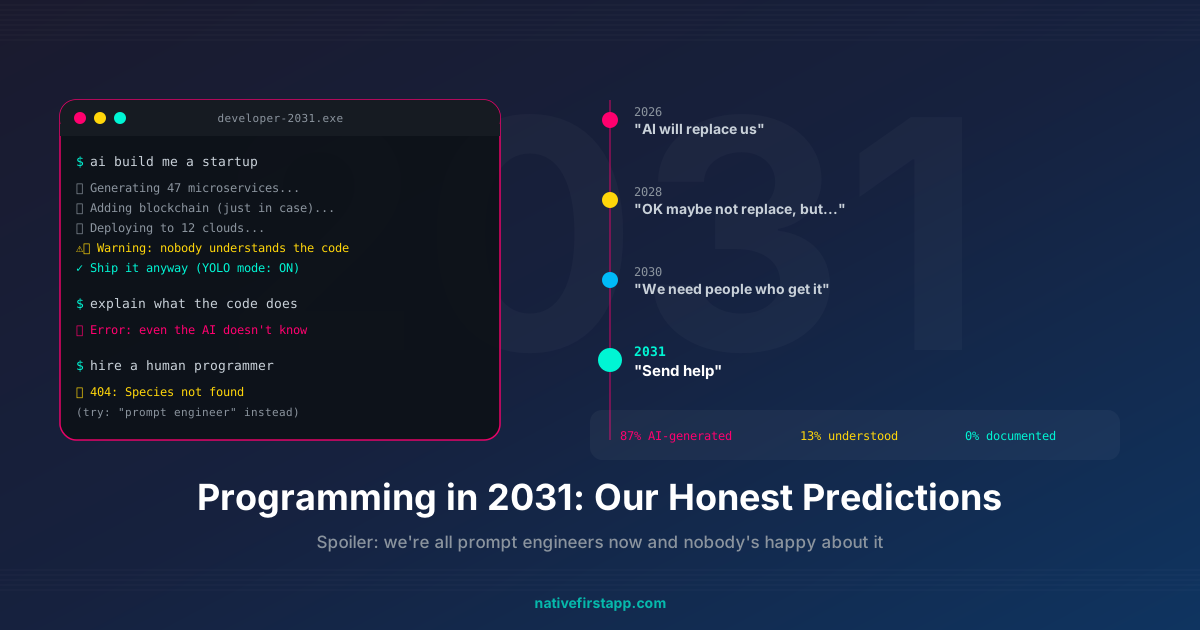
Last Friday, we ordered too much pizza, locked the office door, and tried to answer a question that’s been haunting every developer we know: what does this job look like in five years?
Six people. Three hours. One whiteboard that now looks like a conspiracy theorist’s bedroom wall.
Here’s what we came up with. Some of these are funny. Some are scary. One of them made our senior developer stare at the ceiling for a full minute without blinking.
Prediction 1: “Programmer” Becomes a Weird Word
By 2031, calling yourself a “programmer” will feel like calling yourself a “typist.” Technically accurate. Functionally meaningless.
The actual job titles will be things like AI Systems Architect, Prompt Workflow Engineer, or — and we’re genuinely sorry about this one — Human-in-the-Loop Specialist. LinkedIn will be insufferable. More insufferable. We didn’t think it was possible either.
The reason is simple: the act of writing code character-by-character will be a smaller and smaller part of the job. The important parts — understanding what to build, why, for whom, and what could go wrong — will be the actual skill. You know, the parts that most bootcamps skip entirely.
We already wrote about the gap between vibe coders and real programmers. In five years, that gap becomes a canyon. The people who understand systems will design them. The people who only know how to prompt will be competing with every 14-year-old on the planet.
Prediction 2: The 10x Developer Becomes the 100x Developer (and the 1x Becomes Obsolete)
This is the uncomfortable one.
Right now, a great developer is maybe 10 times more productive than an average one. AI is a multiplier, not an equalizer. It multiplies whatever you bring to the table. If you bring deep understanding, you get 100x. If you bring “I watched a YouTube tutorial once,” you get 100 times that, which is… still not much.
By 2031, we think a single skilled developer with the right AI toolchain will genuinely do the work of what used to be a 5-person team. Not because AI replaces the other four — because AI eliminates the mechanical work that used to justify four salaries.
The grim part: companies will figure this out. Slowly, then all at once. The first round of “efficiency improvements” already happened — we already covered the weird gap between AI adoption and actual productivity gains. We’re in the denial phase where everyone pretends it’s about “augmentation.” By 2028, the pretending stops.
Our honest take: if your only skill is translating Jira tickets into code, start diversifying. Now. Not in a mean way. In a “the tide is coming in and your towel is really far up the beach” way.
Prediction 3: Legacy Code Gets a Second Life
Here’s a prediction nobody’s making: AI is going to make old code more valuable, not less.
Right now, there are millions of lines of COBOL running banking systems, Fortran running simulations, and PHP running… well, everything else. Companies have been terrified to touch this code because nobody understands it and the people who wrote it retired to Florida.
AI changes that equation. Feed a legacy codebase to an AI agent, and suddenly you can understand, document, test, and incrementally modernize code that’s been untouchable for decades. The companies sitting on ancient codebases aren’t holding liabilities anymore — they’re holding assets that just became accessible.
By 2031, “legacy code modernization specialist” will be one of the highest-paying niches in software. The person who can work with AI to untangle a 40-year-old COBOL banking system will be the most popular person at every financial institution on Earth. They might even get a parking spot.
Prediction 4: The Great Prompt Collapse
By 2028 or so, prompting as we know it dies.
Not because it stops working — because it gets absorbed. The same way nobody “writes SQL queries” anymore (you use an ORM), nobody will “write prompts” manually. The prompts will be embedded in tools, workflows, and interfaces. You’ll click a button that says “Generate Tests” and never see the 400-word prompt behind it.
This is already happening. We built PromptKit partly because we saw the transition: raw prompts → saved prompts → automated workflows. The endpoint is prompts disappearing into infrastructure, like how HTTP requests disappeared into fetch().
The people who understand prompt engineering in 2026 will be building the tools that hide it in 2028. By 2031, explaining what a prompt is will be like explaining what a TCP handshake is — technically important, practically invisible to 99% of users.
The irony: prompt engineering is a real and valuable skill right now. It’s also the skill most likely to automate itself out of existence. Use it while you can. Build things with it. Just don’t tattoo it on your forearm.
Prediction 5: We’ll Finally Admit Nobody Tests Enough
This one’s less a prediction and more a prayer.
AI-generated code has a dirty secret: it looks correct. It passes a quick glance. It runs. And then it fails in production in ways that make you question your career choices at 3 AM.
We proved this ourselves when we built the same app twice — once with pure vibes, once with actual engineering. The vibes version had 9 critical security flaws. It looked fine. It ran fine. It would have leaked every user’s data within a week.
By 2031, we think AI-generated code will be so common that testing becomes the most important human skill. Not writing tests (AI can do that). Deciding what to test. Understanding which edge cases matter. Knowing where the AI cut corners because it optimized for “looks right” instead of “is right.”
The job title nobody wants but everybody needs: the person who finds the bugs that the AI is too confident to notice.
Prediction 6: Open Source Gets Weirder
Open source is already having a rough time. AI models trained on open-source code, producing derivative code, with unclear licensing. Maintainers burned out. Corporations using but not contributing.
By 2031, we see two possible futures:
Optimistic: AI makes contributing to open source so easy that participation explodes. The barrier to entry drops. More people contribute. Maintainers use AI to triage issues, review PRs, and write docs. Open source enters a golden age.
Realistic: AI makes forking and modifying code so easy that maintaining a canonical version becomes meaningless. Why contribute upstream when you can just fork, modify, and deploy in 30 seconds? The concept of “the” version of an open-source project dissolves into millions of AI-customized variants. Nobody knows which version has the security fix. Chaos reigns. npm somehow gets worse.
We’re betting on something in between, leaning realistic. Sorry.
Prediction 7: The One We All Agreed On
After three hours of arguing (and a brief tangent about whether hot dogs are sandwiches — they’re not, and we’ll fight you on this), there was exactly one prediction that all six of us agreed on instantly.
The developers who thrive in 2031 will be the ones who understand problems, not just code.
That’s it. That’s the whole thing.
Understanding the problem means knowing why a feature matters, who it’s for, what could go wrong, and what success looks like. It means having opinions about architecture, not just syntax. It means being able to tell an AI “no, that’s the wrong approach” and explaining why — not because you can type faster, but because you’ve been wrong enough times to recognize it in others. Even artificial others.
Every other prediction on this list might be wrong. Models might plateau. The industry might zig when we expected a zag. But this one? This one survives every scenario we could think of.
AI doesn’t replace understanding. It replaces typing. And there’s a universe of difference between those two things.
The Part Where We’re Probably Wrong
Look, predictions are fun and they’re almost always wrong. In 2016, people predicted that by 2021 we’d all be commuting in self-driving cars. In 2021, a self-driving car in San Francisco ran over a traffic cone and got confused.
Maybe AI hits a wall and the next five years are incremental. Maybe there’s a breakthrough we can’t imagine that makes all of this look quaint. Maybe we’re all overthinking it and the real future of programming is just the same thing we’ve always done, slightly faster, with better autocomplete.
But if we had to bet? We’d bet on the developers who are curious, adaptable, and a little bit paranoid. The ones who learn the new tools without forgetting why the old skills matter. The ones who can sit in a room with too much pizza and argue about the future for three hours and leave more excited than scared.
That’s us. Most days.
We’ll revisit this post in 2031 and see how wrong we were. Set a reminder. Bring the pizza.
Related Reading
- Why Knowing Code Still Beats Vibing It — The skills divide that’s only going to get wider.
- I Built the Same App Twice: Vibes vs Code — The experiment that proved AI-generated code needs adult supervision.
- Vibe Coding: The Rumors, The Drama, and What’s Actually Happening — Where we are right now, before the 5-year clock starts.
- The Untapped Power of Claude Nobody Talks About — What AI-augmented development actually looks like today.
Share this post
Comments
Leave a comment
NativeFirst Team
EditorialThe NativeFirst team — engineers and designers building native Apple apps and writing the courses we wish we had when we started.