One Person, One Terminal, Entire Departments: The Untapped Power of Claude Nobody Talks About
Last Tuesday I watched a guy on Medium build an entire marketing system — landing pages, SEO content, video ad scripts, positioning docs, email sequences — in 58 minutes. From one terminal. With Claude Code.
The article was titled “How One Person With Claude Code Just Replaced an Entire Marketing Department.” I read it three times. Not because I didn’t believe it. Because I was calculating how many people in our Slack would have a panic attack if I forwarded it.
Here’s what hit me: most developers I know use Claude like a fancy autocomplete. They ask it to write a function, maybe refactor a component, occasionally explain some legacy code. That’s like buying a Formula 1 car and using it to go grocery shopping. It works. But you’re missing the point entirely.
The Numbers That Made Me Spit Out My Coffee
Let’s start with the stuff that’s hard to argue with.
Claude Code went from $0 to $2.5 billion in annualized revenue in 9 months. That’s the fastest product ramp in the history of B2B software. Not SaaS history. Not AI history. All software history. Bloomberg reported in early March 2026 that Anthropic is now on pace for $20 billion in annual revenue — up from $1 billion just 14 months ago. A 19x increase.
Here’s who’s paying: 8 of the Fortune 10 use Claude. Over 500 companies spend more than $1 million per year on Claude products — up from 12 companies two years ago. Netflix, Spotify, and Salesforce signed multi-year deals.
And here’s the part that made me genuinely laugh: Microsoft — the company that owns GitHub, sells Copilot, and invested $13 billion in OpenAI — has widely adopted Claude Code internally across major engineering teams. Even non-developers at Microsoft are reportedly encouraged to use it. Let that sink in. Microsoft is paying Anthropic to do the thing their own product is supposed to do.
4% of all GitHub public commits are now authored by Claude Code. Projections say 20%+ by year-end 2026. Boris Cherny, the development lead for Claude Code, did 100% of his coding tasks with AI for 30 straight days. Not 80%. Not “mostly.” One hundred percent.
Something massive is happening. And most of us are watching from the sidelines using it to write boilerplate React components.
The Marketing Department Killer
That Medium article by HypergrowthAI wasn’t clickbait. I fact-checked it (yes, I’m that guy).
A marketer named James used Claude Code with layered “Skills” and MCP integrations to build from scratch:
- Competitive research and market positioning
- Full landing page copy and wireframes
- Video ad scripts across three platforms
- SEO-optimized blog content strategy
- Email nurture sequences
- Social media content calendar
Traditional timeline for this work: 8-12 weeks with a team of 4-6 people. Traditional cost: $30,000 to $100,000.
James did it in 58 minutes for roughly $20 in API costs.
The article ended with a line that’s been living rent-free in my head: “The marketing department of the future is one person with Claude Code and a coffee. You can either be that person or compete against them.”
Now, before we all collectively panic: the quality of AI-generated marketing copy still needs human review. Nobody’s arguing you should ship a brand strategy without looking at it. But the first draft? The research phase? The “let me create 40 variations and pick the best three” phase? That part is done. Claude demolished it.
The Billion-Dollar Solopreneur Bet
Dario Amodei, Anthropic’s CEO, went on record saying he believes a billion-dollar company run by a single person will emerge in 2026. When pressed, he put the odds at 70 to 80 percent.
That sounds insane. Then you look at what’s already happening.
The term floating around is “Super Individual” — one person wielding AI tools to operate at the scale of a traditional 50-person company. A TechBullion report documented solo founders hitting $100K+ monthly revenue with 95% lower operating costs than traditional startups. Not billion-dollar companies yet. But the trajectory is straight up.
Claude Cowork — Anthropic’s extension beyond coding — was built in 10 days by its own lead developer. Using Claude Code. A product that lets individuals do enterprise-level knowledge work was itself built by one person with AI. The recursion is almost poetic.
Here’s the thing that keeps me up at night: the limiting factor for solopreneurs used to be time. You could only do so much in a day. AI didn’t remove the limit. It moved it. Now the limiting factor is imagination — knowing what to ask, what to automate, and what to connect. The person who understands their business deeply and knows how to orchestrate AI agents will outpace a team of 20 people who don’t.
n8n + Claude: The Self-Building Automation Engine
OK, this is where it gets truly wild. If you haven’t heard of n8n, it’s an open-source workflow automation platform — think Zapier but you can self-host it and it doesn’t charge per operation.
The old way to use n8n: you’d manually drag nodes around a visual canvas, wire up connections between your apps, configure each step, test it, debug it, test again, swear a little, test again.
The new way: you tell Claude what you want and it builds the entire workflow for you.
This became possible thanks to n8n-MCP — a Model Context Protocol server that exposes your n8n instance as a toolset for Claude. In plain English: Claude can see all your n8n nodes, understand what they do, create new workflows, configure them, and deploy them. From a conversation.
Want to automatically:
- Pull new leads from a form, enrich them with company data, score them, and push high-value ones to your CRM with a Slack notification?
- Monitor competitor pricing pages daily and get a summary email when something changes?
- Take customer support tickets, analyze sentiment, route critical ones to humans, and auto-respond to simple ones?
You describe it. Claude builds it. n8n runs it. You go get coffee.
One developer documented building a complete MVP for an invoice management platform in one day using Claude Code + MCP servers — database setup, email testing, the whole stack. Total API cost: $3.65 for 5.8 million tokens processed.
The Credentials Template pattern is particularly clever: you create a dummy n8n workflow containing all your pre-authenticated connections (Google Sheets, Stripe, Apify, whatever). Claude references this template when building new workflows, so it inherits all your credentials without you ever pasting API keys into a chat window. You can deploy ten different automated workflows without re-authenticating anything.
The MCP Server Rabbit Hole (It Goes Deep)
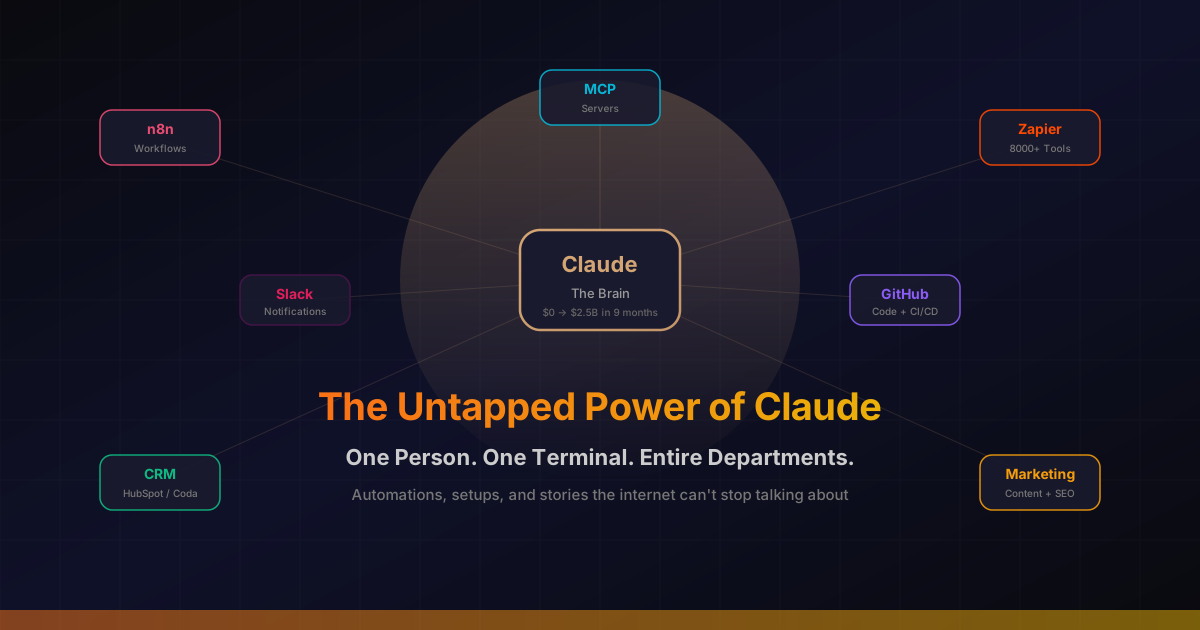
MCP — Model Context Protocol — is Anthropic’s open standard for connecting Claude to external tools. Think of it as a universal adapter. And in 2026, the ecosystem has exploded. There are now 50+ MCP servers available, covering:
- GitHub — Claude reads your repos, creates PRs, reviews code
- Slack — reads channels, posts messages, triggers workflows
- PostgreSQL / databases — queries data, generates reports
- Notion — reads and writes your docs and databases
- Figma — pulls design specs directly into code conversations
- Reddit — community research and social listening (no OAuth needed)
- Zapier — access to 8,000+ individual tools through a single MCP connection
And here’s the kicker: Claude Code’s MCP Tool Search feature uses lazy loading, reducing context usage by up to 95%. You can have all 50+ MCP servers connected simultaneously without blowing up your context window. It just loads the relevant tools when needed.
One developer turned Claude Code into a full “AI Operating System” with persistent workspaces, auto-skills that fire themselves, hooks that notify on Telegram, sub-agents that hand off tasks, and MCP servers plugging into everything. Setup time? Under 30 minutes.
Claude Code can also be an MCP server itself — meaning other AI tools (Cursor, Windsurf, Claude Desktop) can invoke Claude Code remotely. Agents orchestrating agents orchestrating agents. We’ve arrived at the “it’s turtles all the way down” stage of AI development.
Zapier + Claude: 8,000 Tools at Your Fingertips
If n8n is the self-hosted power user’s dream, Zapier is where the non-technical magic happens.
Zapier’s CTO built a system internally where adding an emoji to a Slack thread triggers Claude to analyze the conversation context, generate code, and create a merge request for team review. All from a thumbs-up reaction. That’s not a demo. That’s how they actually work.
Here are some real Zapier + Claude automations that are running in production right now:
Content Machine. Store keywords in Airtable. Zapier triggers Claude to write SEO-optimized articles. Claude sends drafts to Google Docs. Slack notification goes out for review. Human approves. Published. The whole pipeline runs while you sleep.
Intelligent Issue Triage. New bug report comes in. Claude analyzes severity, identifies stakeholders, and branches: critical issues create calendar events + Slack alerts, high-priority gets a scheduled meeting, normal issues get logged. No human touches routine tickets anymore.
Design Approval Flow. Someone submits a design through a form. Claude classifies the asset type, determines which approvers need it, sends approval requests to the right people, updates Slack, fires confirmation emails. The design review process that used to take three days of back-and-forth Slack messages now takes minutes.
CRM Autopilot. Meeting transcript gets uploaded. Claude extracts action items, next steps, and contact details. Automatically updates HubSpot records, creates follow-up tasks, and sends summary emails to attendees. Your CRM updates itself.
And because Zapier charges per workflow execution (not per operation within a workflow), you can build these Rube Goldberg machines of automation without your bill looking like a mortgage payment.
The Setup Nobody Talks About: Claude as Your AI OS
Here’s the setup that blew our minds the most. A developer on DEV Community published a guide for turning Claude Code into a full AI operating system in four layers:
Layer 1: CLAUDE.md — your project’s “constitution.” Rules, conventions, patterns. Claude reads this before every interaction and stays on track.
Layer 2: Skills — repeatable workflows stored as prompts. “Deploy to staging,” “run the full test suite,” “generate release notes.” One command, Claude handles the rest.
Layer 3: Hooks — event-driven automation. Pre-commit checks, post-deploy notifications, auto-formatting. Things that happen around your work without you asking.
Layer 4: Agents + MCP — the full orchestra. Sub-agents that research while you code. MCP servers that connect to your entire tool stack. Claude Code spawning child agents, each with their own context and tools.
The guide estimated setup time at 30 minutes. The productivity gain? The developer reported handling work that previously took their 3-person team.
We set this up internally at NativeFirst last week. Our honest review: Layer 1 and 2 are a no-brainer — we already had CLAUDE.md and Skills changed how we work. Layer 3 (Hooks) requires some tinkering but pays off fast. Layer 4 (full agent orchestration) is where it gets complicated and also where the biggest gains live. It’s not plug-and-play yet. But it’s close.
What Most People Are Missing
Here’s my theory on why 95% of Claude users are using 5% of what it can do:
They think of Claude as a chatbot. You ask a question. It answers. You ask another. It answers again. That’s the mental model from ChatGPT 2023 and it’s dead wrong for Claude Code in 2026.
Claude Code isn’t a chatbot. It’s an orchestration layer. It reads your codebase. It understands your project structure. It spawns background workers. It connects to external services through MCP. It builds automation workflows through n8n. It triggers Zapier actions. It manages your CRM. It generates, tests, and deploys code.
The question isn’t “what can I ask Claude?” The question is “what do I want to stop doing manually?” Whatever the answer is, there’s probably a way to make Claude do it.
Some of the setups people are running right now:
- Customer support autopilot: Incoming tickets get analyzed, categorized, and either auto-responded or escalated with full context summary. Human agents only handle the hard stuff.
- Competitive intelligence: Daily scraping + analysis of competitor changes, pricing updates, and new features. Weekly summary delivered to Slack.
- Content pipeline: From keyword research to draft to SEO optimization to social media distribution. One person manages what used to be a 5-person content team.
- Code review + deployment: Claude reviews PRs, flags issues, suggests fixes, runs tests, and deploys to staging. The developer’s job becomes approving, not doing.
- Sales enablement: Meeting transcripts automatically generate follow-up emails, CRM updates, proposal drafts, and next-step calendars.
Each of these used to be someone’s full-time job. Now they’re a workflow.
The Uncomfortable Part
Let’s address the elephant in the room. This article is about the incredible things Claude can do. But those “incredible things” also represent jobs that real humans currently do.
We’re not going to pretend this is just about productivity. When one person can do the work of ten, nine people have a problem. Anthropic’s own stats show that 55% of companies that rushed to replace humans with AI now regret it — but that means 45% don’t.
The honest answer? The roles are changing, not disappearing entirely. Someone still needs to review Claude’s output. Someone needs to define the strategy. Someone needs to handle the edge cases that make AI hallucinate. But “someone” is one person now where it used to be five. And that transition is going to be messy.
Dario Amodei’s billion-dollar solopreneur isn’t a feel-good story for everyone. It’s a restructuring of how value gets created and who captures it. If you’re reading this blog, you’re probably on the right side of that equation — because you’re learning the tools instead of ignoring them. But we’d be dishonest if we pretended the only story here is upside.
Getting Started (Actually Getting Started)
If you’ve read this far and you’re thinking “OK, I want in,” here’s the unglamorous starting point:
Step 1: Get Claude Code running. If you’re already here, skip. If not, it’s a terminal-based tool — npm install -g @anthropic-ai/claude-code and you’re off. Claude Max subscription ($100/month) or API keys.
Step 2: Create a CLAUDE.md. Put it in your project root. Write your conventions, your stack, your do’s and don’ts. Claude reads it automatically. This alone will improve your output by 30%.
Step 3: Try one MCP server. Start with GitHub MCP or Postgres MCP — whatever connects to something you already use. Get comfortable with Claude pulling real data into conversations.
Step 4: Build one n8n workflow with Claude. Self-host n8n with Docker, install the n8n-MCP server, and ask Claude to build a simple workflow. “Monitor this RSS feed and send a Slack message when a new article matches these keywords.” Start small.
Step 5: Automate one thing you do every week. Weekly status reports. Client follow-ups. Code review triage. Pick one repetitive task and make Claude own it. Once you see the first workflow running without you, you’ll never go back.
Step 6: Scale. Skills, Hooks, sub-agents, Zapier integrations. Each layer adds capability. Go as deep as your use case demands.
The people who will thrive in 2026 aren’t the ones who write the most code or create the most content. They’re the ones who build the best systems. And right now, Claude is the most powerful system-building tool most of us aren’t using to its full potential.
We’ve been setting up these automations internally at NativeFirst for the past month. Some of them are incredible. Some of them caught fire immediately. We’ll probably write about both. In the meantime, if you build something wild with Claude + n8n + MCP, we want to hear about it.
Happy automating. Don’t forget to review the output.
Share this post
Comments
Leave a comment
NativeFirst R Team
Research TeamThe NativeFirst Research Team. We dig through the noise so you get the signal. Opinions are our own, coffee is mandatory.