Why Knowing Code Still Beats Vibing It: Programmers vs Vibe Coders in 2026
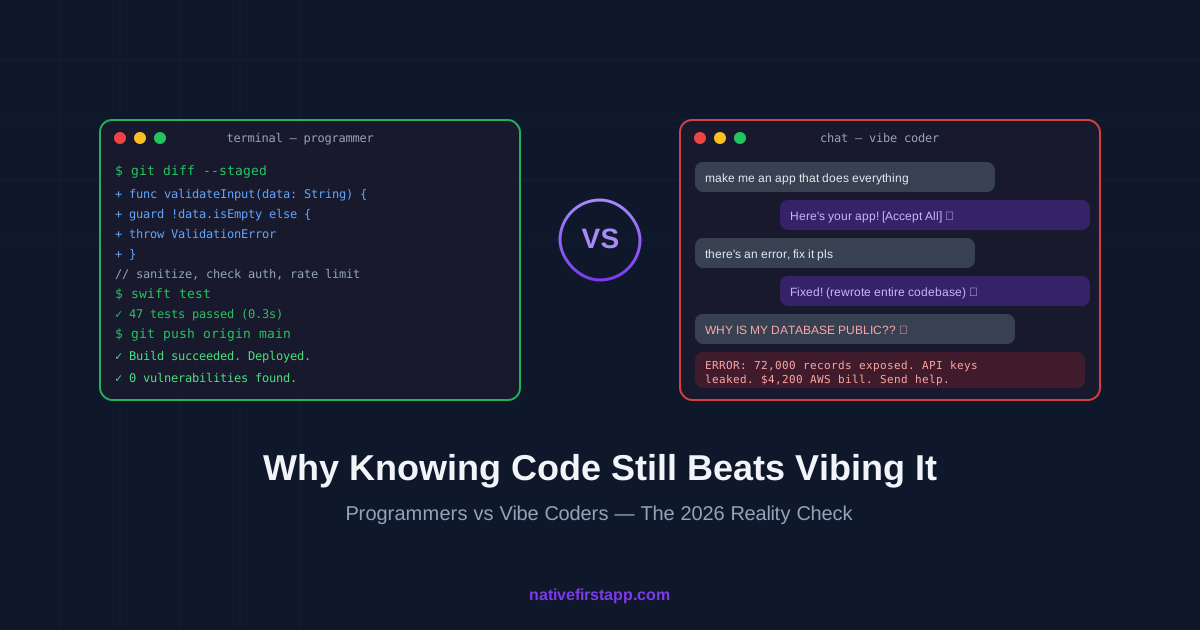
Last week I watched a guy on X announce he built “a full SaaS product in 4 hours, zero coding experience.” Two days later, he was begging for help because hackers had bypassed his subscription system, maxed out his API keys, and racked up a bill that would make your landlord blush.
That tweet got 2 million views. The follow-up got even more. And I sat there thinking: this is the best advertisement for learning to code I’ve ever seen.
The Vibe Coding Promise (And Why It’s Seductive)
Let’s rewind. February 2025. Andrej Karpathy — co-founder of OpenAI, former AI lead at Tesla, generally a guy who knows things — fires off a tweet:
“There’s a new kind of coding I call ‘vibe coding’, where you fully give in to the vibes, embrace exponentials, and forget that the code even exists.”
4.5 million views. Collins Dictionary Word of the Year. And suddenly every non-technical founder on the planet thought they didn’t need developers anymore.
The pitch is genuinely compelling: describe what you want in plain English, hit enter, get a working app. A hair salon owner in Portland built an inventory tracker over a weekend. Y Combinator reported that a quarter of their current batch has codebases that are 95%+ AI-generated. People are shipping real things.
So what’s the problem?
The 70% Trap
Here’s what every vibe coder discovers eventually: AI gets you about 70% of the way there. The first draft looks amazing. You show your friends. You post it on X. You feel like a god.
Then you try to add a second feature. And a third. And suddenly nothing works, the app is doing things you never asked for, and the error messages look like they were written by a drunk philosopher.
Columbia University researchers identified 9 key failure patterns in AI coding agents. The nastiest ones? Silent failures. The code runs fine. No errors. No warnings. It just… doesn’t do what you asked. Your payment system looks perfect but charges people twice. Your login works beautifully but stores passwords in plain text. Your database is technically functional but also technically accessible to anyone with a browser.
This is the part that scares me. Not the errors you can see — the ones you can’t.
The Security Horror Show
I’m not being dramatic. These things actually happened:
The SaaS that got hacked live on X. In March 2025, a vibe coder bragged about his cheap-to-build SaaS. Then hackers showed up. Subscriptions bypassed, database flooded with junk, API keys maxed out. He went from “look what I built” to “please help me” in 48 hours. The internet watched in real time.
The dating app that exposed 72,000 photos. The Tea Dating Advice app — built with AI assistance — had a misconfigured Firebase storage bucket. Hackers accessed every image in the database. An experienced developer would’ve caught that in a code review. It took a hacker about five minutes.
Lovable’s 170 vulnerable apps. In May 2025, researchers found that 170 out of 1,645 web apps built with Lovable (a popular vibe coding platform) had security flaws that could expose personal information to anyone. That’s roughly 1 in 10. Would you fly in a plane where 1 in 10 had faulty landing gear?
The numbers are brutal. A CodeRabbit analysis of 470 open-source pull requests found AI-generated code has 2.74x more XSS vulnerabilities and 1.7x more issues overall than human-written code. Escape’s broader study later found over 2,000 vulnerabilities across 5,600 vibe-coded apps. Not a rounding error. A pattern.
”But I Don’t Need to Understand It, the AI Handles That”
I hear this a lot. And I get it. It sounds logical.
Here’s the thing though: writing code was never the hard part.
Ask any developer what takes the most time and they won’t say typing. They’ll say debugging. Architectural decisions. Figuring out why the app works on their machine but crashes in production. Understanding what the code is actually doing versus what it looks like it’s doing.
Vibe coding is like having a super fast chauffeur who doesn’t know the difference between a highway and a cliff. Sure, you’ll get somewhere quickly. The question is whether you’ll like where you end up.
MIT’s Daniel Jackson called it “a bit of an impending disaster” — warning about “masses of broken code, full of security vulnerabilities” and “a new generation of programmers incapable of dealing with those vulnerabilities.”
When vibe coding fails (and it will), you have exactly two options:
- Pay a senior developer $200/hour to untangle the mess
- Ask the AI to fix it, which often means it rewrites everything and introduces three new bugs
I’ve seen option 2 play out dozens of times. One developer on Reddit described it perfectly: “AI will fix one thing but destroy 10 other things in your code.” You end up in a loop — fix, break, fix, break — until you either give up or call someone who actually knows what they’re doing.
What Programmers See That Vibe Coders Don’t
This isn’t about gatekeeping. It’s about what your eyes can do when they’re trained to read code.
You spot the silent killers. A vibe coder sees a login form that works. A programmer sees that the form sends passwords over HTTP instead of HTTPS, doesn’t hash them before storage, and has no rate limiting against brute force attacks. Same form. Completely different risk assessment.
You understand the architecture. When the AI generates 2,000 lines of code, a programmer can tell you if that architecture will handle 100 users or 100,000. A vibe coder can tell you… it works on their laptop.
You debug instead of rewrite. When something breaks, a programmer narrows it down. Reads the stack trace. Checks the logs. Finds the one line that’s wrong. A vibe coder pastes the error into the chat and hopes for the best — and the AI, lacking context about the full system, often makes things worse.
You know what to ask for. This is the sneaky one. The biggest advantage of knowing code isn’t writing it — it’s knowing what to tell the AI to write. A vibe coder says “build me a user system.” A programmer says “build me a user system with bcrypt password hashing, JWT token authentication with refresh tokens, rate-limited login endpoints, and input sanitization against SQL injection.” Same request. Wildly different results.
As one Reddit user put it: “AI is like working with a really fast, overconfident intern.” And if you’ve ever managed an overconfident intern, you know the most important skill isn’t doing their work — it’s reviewing it.
The Career Reality Nobody Wants to Hear
Here’s the uncomfortable part.
18 CTOs were surveyed in August 2025. 16 of them reported production disasters caused directly by AI-generated code. That’s 89%. These aren’t hypothetical risks. These are real companies losing real money because someone shipped code nobody understood.
The job market is splitting into two lanes:
Lane 1: Prompt jockeys. People who can get AI to spit out code but can’t evaluate what it produces. They’re fast. They’re cheap. And they’re increasingly replaceable — because if anyone can prompt an AI, what’s your competitive advantage?
Lane 2: Developers who use AI as a power tool. They write code. They also use Cursor, Claude, Copilot — whatever makes them faster. But they review every line. They understand the architecture. They catch the bugs the AI introduces. These people are becoming more valuable, not less. (We wrote about this exact dynamic in our piece on the AI productivity paradox — the data is wild.)
Karpathy himself figured this out. A year after coining “vibe coding,” he’s now pushing a new term: “agentic engineering” — where you orchestrate AI agents but maintain full oversight and quality control. Even the guy who started the vibe movement is saying: the vibes aren’t enough.
The 10x Developer Joke That Aged Badly
Someone on Reddit nailed it: “AI promised to make us all 10x developers, but instead it’s making juniors into prompt engineers and seniors into code janitors cleaning up AI’s mess.”
Harsh? Sure. But look at the METR study from 2025: experienced open-source developers using AI tools were actually 19% slower than without them. Not because the tools are bad, but because the overhead of reviewing, correcting, and integrating AI suggestions ate up the time savings. The kicker? Developers thought they were 20% faster. Perception and reality, doing the tango in opposite directions.
The developers who benefit most from AI are the ones who were already good. They use AI to skip the boring parts — boilerplate, repetitive patterns, initial scaffolding — and spend their time on the parts that actually matter: architecture, security, performance, edge cases.
If you don’t know what those words mean, AI can’t help you care about them.
So Should You Learn to Code in 2026?
Yes. More than ever.
Not because AI is bad. AI is incredible. I use it every day and it makes me genuinely better at my job. But it makes me better because I know enough to steer it, correct it, and catch it when it’s confidently wrong.
Learning to code in 2026 doesn’t mean memorizing syntax. It means understanding:
- How data flows through an application
- What security means at each layer
- Why certain architectures scale and others collapse
- How to read what the AI gives you and know if it’s good
You don’t need to become a 20-year veteran. But you need enough knowledge to be a competent reviewer. Think of it like this: you don’t need to be a mechanic to drive a car. But if you’re racing in Formula 1, you better damn well know how the engine works.
The Bottom Line
Vibe coding is a superpower for prototyping. It’s a disaster for production. And the gap between those two things is filled by one thing: knowing what you’re looking at.
The people who’ll win in the AI era aren’t the ones who can prompt the fastest. They’re the ones who can look at AI-generated code and say “this works, ship it” or “this will expose our entire user database on day two, rewrite it.”
That ability doesn’t come from vibes. It comes from learning.
The AI writes the code. You need to be the one who knows if it’s any good.
Have thoughts on this? Building something with AI and wondering where the line is? Drop a comment or reach out — I genuinely love hearing vibe coding war stories. Especially the ones that start with “so I shipped to production without reading the code…”
Related Reading
From NativeFirst:
- The Rumors, The Drama, and What’s Actually Happening with Vibe Coding — our deep dive into the internet discourse
- Open Source Is Dying and Vibe Coding Is Holding the Pillow — how AI-generated contributions are killing open source maintainers
- The AI Productivity Paradox — why AI tools aren’t making us as productive as we think
- Vibe Coding iOS Apps: A Comprehensive Analysis — what happens when you try to vibe code a real native app
External sources referenced in this article:
- Andrej Karpathy’s original “vibe coding” tweet — the tweet that started everything
- Karpathy’s one-year retrospective — “a shower of thoughts throwaway tweet”
- Columbia University: 9 Critical Failure Patterns of AI Coding Agents
- METR Study: AI Makes Experienced Developers 19% Slower
- CodeRabbit: State of AI vs Human Code Generation
- Semafor: Lovable Is a Sitting Duck for Hackers
- Decrypt: Tea App Exposes 72,000 IDs
- Final Round AI: What CTOs Really Think About Vibe Coding
- Addy Osmani: Vibe Coding Is Not AI-Assisted Engineering
- Stack Overflow: A New Worst Coder Has Entered the Chat
- Red Hat: The Uncomfortable Truth About Vibe Coding
- Escape: 2,000+ Vulnerabilities in Vibe-Coded Apps
- TechCrunch: 25% of YC Startups Have 95% AI-Generated Code
Share this post
Comments
Leave a comment
Mario
Founder & CEOFounder of NativeFirst. Building native Apple apps with SwiftUI and a passion for great user experiences.