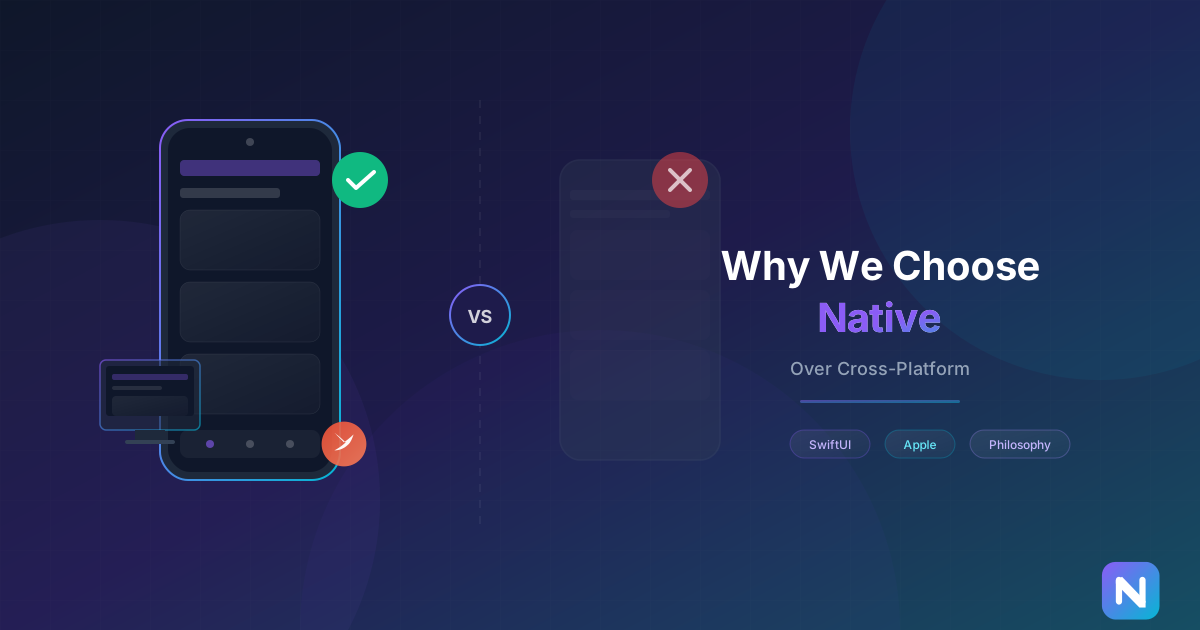
Why We Choose Native Over Cross-Platform
Every time we start a new project, the question comes up: should we go native, or reach for a cross-platform framework? For us at NativeFirst, the answer is always the same. We build native, and here is why.
The Case for Native
Cross-platform tools like React Native, Flutter, and .NET MAUI have come a long way. They let you write code once and ship to multiple platforms, which sounds efficient on paper. But efficiency in development does not always translate to quality in the product.
When you build natively with SwiftUI, you get:
- Platform-native look and feel. Your app behaves exactly the way users expect. Navigation patterns, gestures, animations, and system integrations all work out of the box because you are using the same frameworks Apple builds their own apps with.
- Performance without compromise. There is no bridge layer, no virtual DOM, no JavaScript runtime sitting between your code and the hardware. SwiftUI views compile to native platform primitives.
- Day-one access to new features. When Apple announces a new API at WWDC, you can adopt it immediately. Cross-platform frameworks often lag months or even years behind.
- Smaller binary size. Native apps do not need to bundle an entire runtime or rendering engine. The frameworks are already on the user’s device.
Where Cross-Platform Falls Short
The biggest issue with cross-platform development is not the code — it is the compromises. Every platform has its own design language, its own conventions, and its own user expectations. When you try to abstract across all of them, you end up with an app that does not feel truly at home anywhere.
We have seen it time and again: apps that look almost right but scroll slightly wrong, that miss the subtle haptic feedback users expect, that do not integrate with Spotlight or Shortcuts or the share sheet the way a native app would.
These details might seem small, but they add up. Users notice when an app does not feel native, even if they cannot articulate exactly why.
SwiftUI Changed Everything
A few years ago, building native meant writing significantly more code. UIKit on iOS and AppKit on macOS were powerful but verbose, and sharing logic between platforms was genuinely difficult.
SwiftUI changed the equation. With SwiftUI, we write declarative UI code that adapts naturally to each platform. A single NavigationSplitView becomes a sidebar on macOS and a navigation stack on iPhone. A List gets platform-appropriate styling automatically. We get multiplatform support while staying fully native.
Combined with Swift’s modern language features — structured concurrency, result builders, property wrappers — the developer experience is better than it has ever been.
Our Philosophy
We are not saying cross-platform is never the right choice. For some teams, some products, and some constraints, it makes sense. But for us, building apps that feel like they belong on Apple platforms is the entire point.
Our users do not care what framework we used. They care that the app launches fast, responds to their input smoothly, respects their system settings, and works the way every other good app on their device works. Native development is how we deliver on that promise.
When you open Invoize on your Mac, we want it to feel like it was always part of macOS. When you use ThinkBud on your iPhone, it should feel like Apple could have built it. That level of integration and polish is what drives us.
Looking Ahead
SwiftUI is still evolving rapidly. Every year brings new components, better performance, and deeper platform integration. We are investing in native development not just because it is good today, but because we believe the trajectory only gets better.
If you are an indie developer weighing native versus cross-platform for your next project, we would encourage you to give SwiftUI a serious look. The learning curve is worth it, and the result is software you can be proud of.
We will be sharing more about our SwiftUI workflow, architecture patterns, and lessons learned in upcoming posts. If that sounds interesting, stick around.
Share this post
Comments
Leave a comment
Mario
Founder & CEOFounder of NativeFirst. Building native Apple apps with SwiftUI and a passion for great user experiences.