Retry, Token Refresh, and Request Deduplication in Swift

Day 22 ended with a confession: the 85-line networking layer I’d just built was a toy. Not because it was wrong — the tests were green, the BrewLog tip card really did fetch from a real local server — but because it had never met a flaky connection, an expired token, or two views asking for the same thing at the same time. I said that was Day 23. It’s Day 23.
Three production concerns, three actors, and — I’ll get to this — one genuine concurrency bug that showed up in the ninth test I wrote, not in the code it was testing.
Why these three, and why actors
Retry, token refresh, and request deduplication all share a property: they’re about state that has to stay correct while multiple callers hit it at once. A retry counter, a cached token, an in-flight request — if two requests can mutate any of those at the same time, you get a duplicate refresh call, a retry that fires twice, or a cache that never clears.
That’s exactly the job description of a Swift actor. And it’s worth a callback to Day 1: BrewLog builds with SWIFT_DEFAULT_ACTOR_ISOLATION = MainActor, meaning every plain struct or class in this project runs on the main thread unless told otherwise. An actor is the one declaration that opts out of that default — it carves out its own isolation domain no matter what the project-wide setting says. That’s not incidental here. It’s the entire reason the next two types are actors and not structs.
Token refresh: one refresh, however many callers
The naive fix for an expired token is “catch the 401, refresh, retry.” The naive fix breaks the moment two requests 401 at once — both see the token as stale, both call the refresh endpoint, and now you’ve got two refresh calls racing, possibly invalidating each other’s token.
AuthTokenStore exists to make that structurally impossible:
actor AuthTokenStore {
    private(set) var currentToken: String
    private var refreshTask: Task<String, Error>?
    private let refresher: () async throws -> String

    init(initialToken: String, refresher: @escaping () async throws -> String) {
        self.currentToken = initialToken
        self.refresher = refresher
    }

    func refreshedToken() async throws -> String {
        if let refreshTask {
            return try await refreshTask.value
        }

        let task = Task { try await refresher() }
        refreshTask = task
        defer { refreshTask = nil }

        let token = try await task.value
        currentToken = token
        return token
    }
}
The trick is the refreshTask property. The first caller to arrive finds it nil, creates the real refresh Task, and stores it before awaiting it. Every caller that arrives while that’s in flight finds the stored task and just awaits the same one — no second network call, no second currentToken write. Ten callers racing for a refresh trigger exactly one HTTP request:
@Test("ten callers racing for a refresh only trigger the network call once")
func concurrentCallersShareOneRefresh() async throws {
    let refreshCount = Counter()
    let store = AuthTokenStore(initialToken: "stale") {
        await refreshCount.increment()
        try? await Task.sleep(for: .milliseconds(50))
        return "fresh"
    }

    let results = try await withThrowingTaskGroup(of: String.self) { group -> [String] in
        for _ in 0..<10 {
            group.addTask { try await store.refreshedToken() }
        }
        var collected: [String] = []
        for try await token in group { collected.append(token) }
        return collected
    }

    #expect(results == Array(repeating: "fresh", count: 10))
    #expect(await refreshCount.value == 1)
}
Test case 'AuthTokenStoreTests/refreshUpdatesCurrentToken()' passed (0.000 seconds)
Test case 'AuthTokenStoreTests/concurrentCallersShareOneRefresh()' passed (1.000 seconds)This pattern has a name — single-flight — and it’s the same shape whether you’re refreshing a token, warming a cache, or deduplicating a request. Which is the next section.
Request deduplication: forgetting what type you’re holding
Two views asking for the same tip at the same time shouldn’t mean two HTTP calls. The fix again is “if a request for this key is already in flight, hand the caller that one instead of starting a new one” — but a generic networking layer has to coalesce requests for any Decodable type, in one dictionary, which means the cache has to forget what type it’s holding:
actor RequestDeduplicator {
    private var inFlight: [String: Task<Any, Error>] = [:]

    func value<T>(for key: String, as type: T.Type, perform: @escaping () async throws -> T) async throws -> T {
        if let existing = inFlight[key] {
            guard let result = try await existing.value as? T else {
                throw APIError.decoding("Deduplicated request resolved to an unexpected type.")
            }
            return result
        }

        let task = Task<Any, Error> { try await perform() }
        inFlight[key] = task
        defer { inFlight[key] = nil }

        guard let result = try await task.value as? T else {
            throw APIError.decoding("Deduplicated request resolved to an unexpected type.")
        }
        return result
    }
}
Task<Any, Error> plus a cast back to T on the way out. It’s a little ugly, and I’m not going to pretend otherwise — every generic request-coalescer I’ve ever seen ends up here one way or another, because the alternative is a separate dictionary per type, which doesn’t compose.
The bug that was in the test, not the code
Here’s where Day 23 stopped being a normal Tuesday.
The obvious test for RequestDeduplicator is two concurrent calls for the same key:
async let first = deduplicator.value(for: "tips/today", as: String.self) {
    await callCount.increment()
    return "first"
}
async let second = deduplicator.value(for: "tips/today", as: String.self) {
    await callCount.increment()
    return "second"
}

let (firstResult, secondResult) = try await (first, second)
#expect(firstResult == secondResult)
#expect(await callCount.value == 1)
I ran it. It failed:
Expectation failed: (firstResult → "first") == (secondResult → "second")
Expectation failed: await callCount.value == 1
callCount was 2. Both closures had run. The actor I’d just convinced you can’t have two callers create their own task for the same key had, apparently, let exactly that happen.
I spent longer than I’d like to admit assuming I had an actor-isolation bug — that somehow two callers were seeing an empty cache “at the same time.” So I pulled the actor out into a standalone script, ran it 200 times in a loop with print statements at every step, and watched what actually happened:
[A] entered value(), inFlightKeys=[]
[A] becoming the in-flight runner, inserting key
    >>> A perform() running
[A] perform() finished with success("first")
[A] resolving 0 waiters
[B] entered value(), inFlightKeys=[]
[B] becoming the in-flight runner, inserting key
    >>> B perform() running
[B] perform() finished with success("second")
[B] resolving 0 waiters
There’s the bug, and it’s not in the actor. A runs to completion — including clearing its own cache entry — before B even starts. async let schedules two child tasks; it doesn’t promise they’ll actually overlap.
When neither closure does any real asynchronous work, the runtime can — and regularly does — run the first one start-to-finish before the second gets a turn. By the time B checks the cache, A has already finished and cleaned up after itself. The two calls never collide, so there’s nothing to deduplicate — the test that was supposed to prove concurrency safety was quietly testing two sequential calls instead.
Over 200 runs of the standalone version, that happened 34 times. Not rare. Not exotic. A coin you’d lose to roughly one time in six.
The fix isn’t in RequestDeduplicator — it was already correct. The fix is making the test force the overlap it claims to be testing, instead of hoping for it:
let firstHasStarted = Gate()

let firstTask = Task {
    try await deduplicator.value(for: "tips/today", as: String.self) {
        await callCount.increment()
        await firstHasStarted.open()
        try? await Task.sleep(for: .milliseconds(20))
        return "first"
    }
}

await firstHasStarted.wait()

let secondResult = try await deduplicator.value(for: "tips/today", as: String.self) {
    await callCount.increment()
    return "second"
}
let firstResult = try await firstTask.value

#expect(firstResult == "first")
#expect(secondResult == "first")
#expect(await callCount.value == 1)
Gate is eight lines wrapping a CheckedContinuation — open() resumes whoever’s waiting, wait() suspends until someone calls open(). The test now knows the first call has registered itself before the second one fires, instead of crossing its fingers. Back in Xcode, on the real target:
Test case 'RequestDeduplicatorTests/concurrentCallsShareOneInFlightTask()' passed (0.000 seconds)Green on every run since, including the back-to-back retry Xcode does automatically on a failure — the same repeat-on-failure mechanism that, before this fix, had quietly caught and re-confirmed the bug twice in the same invocation.
The lesson generalizes past this one test: if a “concurrent” test doesn’t force the overlap it’s trying to prove — with a continuation, a sleep, anything that guarantees the second call arrives while the first is still working — it isn’t testing concurrency. It’s testing the scheduler’s mood that day. Day 22’s .serialized fix was the test harness lying about isolation; this one is the test design lying about overlap. Same family of bug, opposite end of the suite.
Retry: only for failures that deserve a second try
Retry is the simplest of the three and the easiest to get wrong in the other direction — retrying a 404 doesn’t fix a 404, it just makes the user wait three times longer to find out their request was always going to fail.
private static func isRetryable(_ error: APIError) -> Bool {
    switch error {
    case .transport:
        return true
    case .badStatus(let code):
        return (500...599).contains(code)
    case .invalidURL, .decoding:
        return false
    }
}
Transport failures and 5xx responses get up to two retries with linear backoff (200ms, then 400ms). Everything else — a bad URL, a 404, a malformed body — fails immediately, because trying again can’t change the answer.
Composing all three
ResilientNetworkClient is a decorator: it implements the same NetworkClient protocol it wraps, so nothing that calls it — BrewTipsService, the view model, a future feature — has to know it exists.
struct ResilientNetworkClient: NetworkClient {
    let wrapped: NetworkClient
    let authTokenStore: AuthTokenStore
    let deduplicator: RequestDeduplicator
    var maxRetries: Int = 2

    func send<T: Decodable>(_ endpoint: Endpoint, as type: T.Type) async throws -> T {
        let key = "\(endpoint.method) \(endpoint.path)?\(endpoint.queryItems)"
        return try await deduplicator.value(for: key, as: T.self) {
            try await sendWithRetryAndAuth(endpoint, as: T.self)
        }
    }

    private func sendWithRetryAndAuth<T: Decodable>(
        _ endpoint: Endpoint,
        as type: T.Type,
        attempt: Int = 1,
        didRefreshToken: Bool = false
    ) async throws -> T {
        var request = endpoint
        if request.requiresAuth {
            request.headers["Authorization"] = "Bearer \(await authTokenStore.currentToken)"
        }

        do {
            return try await wrapped.send(request, as: T.self)
        } catch APIError.badStatus(401) where request.requiresAuth && !didRefreshToken {
            // Refreshing is itself just a network call — but it must never
            // route back through this same client, or a 401 on the refresh
            // endpoint would try to refresh itself forever.
            _ = try await authTokenStore.refreshedToken()
            return try await sendWithRetryAndAuth(endpoint, as: T.self, attempt: attempt, didRefreshToken: true)
        } catch let error as APIError where Self.isRetryable(error) && attempt <= maxRetries {
            try await Task.sleep(for: .milliseconds(200 * attempt))
            return try await sendWithRetryAndAuth(endpoint, as: T.self, attempt: attempt + 1, didRefreshToken: didRefreshToken)
        }
    }
}
Dedup wraps the outside, because two callers asking for the same thing should share one whole attempt — retries, auth refresh, and all. Inside that, every retry recomputes the Authorization header from endpoint (the original, not the locally mutated copy), which means a retry that follows a token refresh automatically picks up the new token. No extra plumbing for that — it falls out of recursing on the unmodified parameter instead of the mutated local.
The didRefreshToken flag caps the auth-recovery path at exactly one refresh-and-retry. If the freshly refreshed token also 401s, the error propagates instead of looping — a token that’s rejected right after a successful refresh means something is actually wrong, not stale.
Five tests cover the orchestration through a fake NetworkClient, not a real URLSession — the same “test the seam, not the transport” call Day 19’s DI post made:
Test case 'ResilientNetworkClientTests/retriesTransientFailure()' passed (1.000 seconds)
Test case 'ResilientNetworkClientTests/doesNotRetryClientErrors()' passed (0.000 seconds)
Test case 'ResilientNetworkClientTests/refreshesTokenOn401()' passed (0.000 seconds)
Test case 'ResilientNetworkClientTests/doesNotRefreshForUnauthenticatedEndpoints()' passed (0.000 seconds)
Test case 'ResilientNetworkClientTests/deduplicatesConcurrentCalls()' passed (0.000 seconds)
Proving it against the real server
BrewLog’s TipOfTheDay card now builds its client with all three layers wrapped around Day 22’s URLSessionNetworkClient, starting with a deliberately stale token:
private static func makeClient() -> NetworkClient {
    let baseURL = URL(string: "http://127.0.0.1:8080")!
    let transport = URLSessionNetworkClient(baseURL: baseURL)

    let authTokenStore = AuthTokenStore(initialToken: "expired-token") {
        let dto = try await transport.send(
            Endpoint(path: "auth/refresh", method: "POST"),
            as: TokenRefreshDTO.self
        )
        return dto.token
    }

    return ResilientNetworkClient(
        wrapped: transport,
        authTokenStore: authTokenStore,
        deduplicator: RequestDeduplicator()
    )
}
Note the refresher closure calls transport directly, not the ResilientNetworkClient being built — exactly the “never route the refresh through itself” rule from a few sections up.
Pointed at the same nine-line Python server from Day 22, now requiring a bearer token on /tips/today and serving /auth/refresh, the very first launch produces this server log:
401 — rejected token: 'Bearer expired-token'
200 — issued a fresh token
200 — tip served with a valid token
That’s the whole story in three lines: BrewLog tried with the stale token it started with, got rejected, refreshed without anyone asking it to, and retried successfully — all before the card finished its first render:
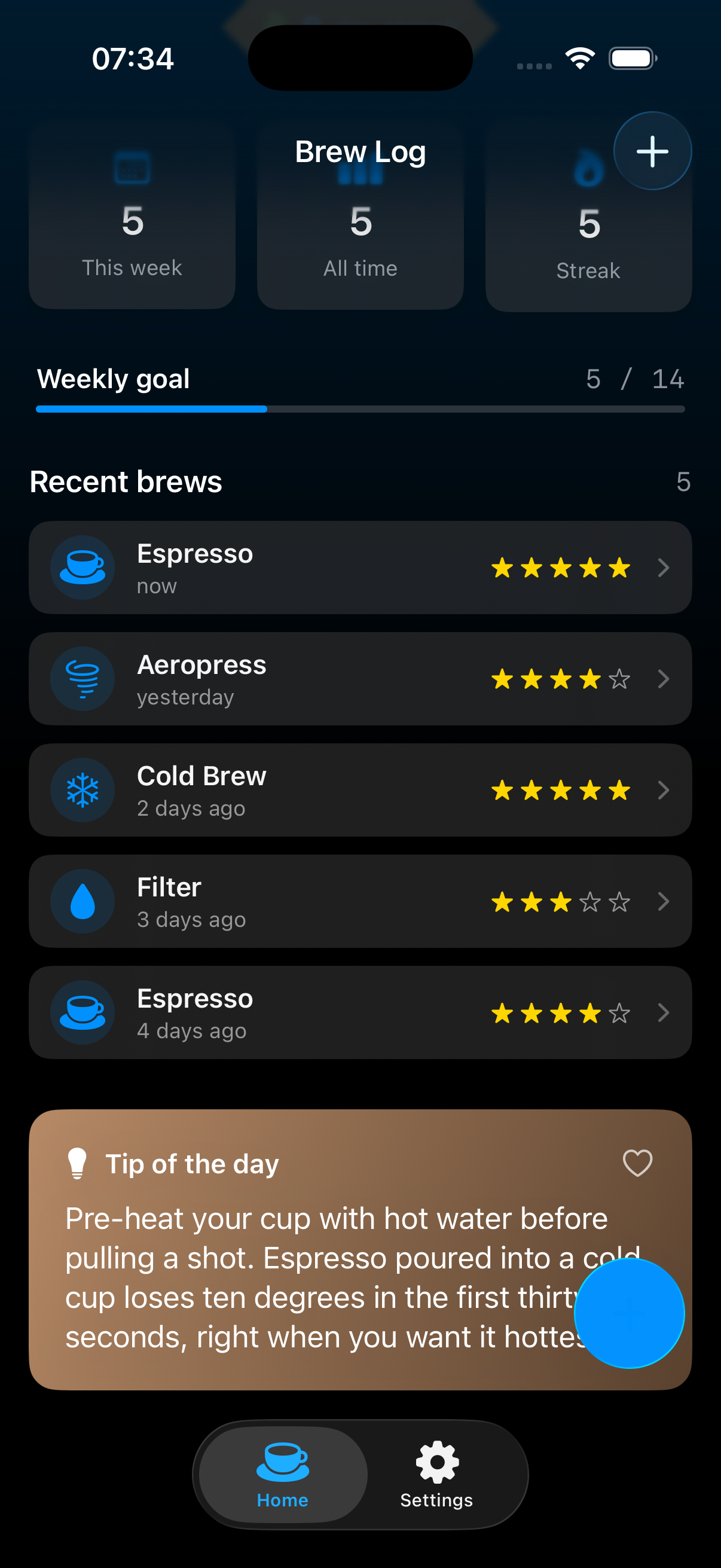
The view’s code didn’t change to make this work. It still just calls service.fetchTipOfTheDay() and switches on idle/loading/loaded/failed. That’s the actual payoff of building this as a decorator: the resilience lives entirely below a protocol the view never sees past.
The short version
| Piece | Lines | Job |
|---|---|---|
AuthTokenStore | 32 | One refresh in flight, however many callers ask |
RequestDeduplicator | 28 | One real request in flight per key |
ResilientNetworkClient | 56 | Composes both plus bounded, selective retry |
116 new lines, nine new tests, and a bug that was in the test suite’s assumptions about async let, not in a single line of the actors it was testing. If you want a curriculum that treats “the test had the bug” as a normal Tuesday instead of an embarrassing footnote, that instinct — write it red, trust the failure, find out which side actually lied — is the spine of the SwiftUI at Scale course.
Day 23 of the 30-day iOS development series. Yesterday: a custom networking layer in 100 lines. Tomorrow: SOLID principles in Swift, with the receipts from a real early commit instead of a slide deck.
Share this post
Comments
Leave a comment
Mario
Founder & CEOFounder of NativeFirst. Building native Apple apps with SwiftUI and a passion for great user experiences.