
A Custom Networking Layer in 100 Lines of Swift — No Alamofire

BrewLog’s “Tip of the day” card has shown the exact same tip since the project’s first commit. Not a bug, exactly — unlike Day 21’s streak counter, it isn’t lying to anyone. The grind-size advice is genuinely good. It’s just frozen, because it’s a string literal sitting inside a SwiftUI view:
Text("Grind size matters more than dose. If your espresso pulls fast and tastes sour, go finer...")Every tutorial that adds “fetch this from a server” to an app reaches for the same first instinct: paste a URLSession.shared.data(for:) call directly into the view or the view model, try? the JSON decode, move on. Do that four or five times across an app and you’ve got four or five slightly different ideas of what a failed request even means — one spot crashes on a bad status code, another silently shows nothing, a third decodes garbage into half-populated optionals and calls it a day.
So today’s the day the tip gets a real backend call. Let’s build the smallest networking layer that doesn’t paint us into that corner.
Why not Alamofire, why not Moya
Both are good libraries. Neither is solving a 2026 problem anymore.
Alamofire and Moya exist because, in the completion-handler era, URLSession was genuinely painful — nested callbacks, manual response validation, no built-in JSON pipeline. async/await removed almost all of that pain from the standard library itself. What’s left to build on top is small enough to own: a way to describe a request, a way to send it and get a typed result back, and a way to talk about what went wrong. That’s three types, not a dependency.
Owning it also means zero black boxes when something breaks at 11 PM and the stack trace runs through code you didn’t write.
The three pieces
Endpoint describes a request without knowing how to send one:
struct Endpoint {
    var path: String
    var method: String = "GET"
    var queryItems: [URLQueryItem] = []
}
APIError is the one vocabulary every call site speaks, instead of four different optional-unwrapping conventions:
enum APIError: Error, Equatable {
    case invalidURL
    case transport(String)
    case badStatus(Int)
    case decoding(String)
}
NetworkClient is the protocol that does the actual work, with URLSessionNetworkClient as the one real implementation:
protocol NetworkClient {
    func send<T: Decodable>(_ endpoint: Endpoint, as type: T.Type) async throws -> T
}

struct URLSessionNetworkClient: NetworkClient {
    let baseURL: URL
    let session: URLSession

    init(baseURL: URL, session: URLSession = .shared) {
        self.baseURL = baseURL
        self.session = session
    }

    func send<T: Decodable>(_ endpoint: Endpoint, as type: T.Type) async throws -> T {
        guard var components = URLComponents(
            url: baseURL.appendingPathComponent(endpoint.path),
            resolvingAgainstBaseURL: false
        ) else {
            throw APIError.invalidURL
        }
        components.queryItems = endpoint.queryItems.isEmpty ? nil : endpoint.queryItems

        guard let url = components.url else {
            throw APIError.invalidURL
        }

        var request = URLRequest(url: url)
        request.httpMethod = endpoint.method

        let data: Data
        let response: URLResponse
        do {
            (data, response) = try await session.data(for: request)
        } catch {
            throw APIError.transport(error.localizedDescription)
        }

        guard let http = response as? HTTPURLResponse else {
            throw APIError.invalidURL
        }
        guard (200..<300).contains(http.statusCode) else {
            throw APIError.badStatus(http.statusCode)
        }

        do {
            return try JSONDecoder().decode(T.self, from: data)
        } catch {
            throw APIError.decoding(error.localizedDescription)
        }
    }
}
That’s the entire transport layer. Endpoint.swift, NetworkClient.swift, and the one concrete service below come to 85 lines, counted, not rounded up for a catchy headline:
$ wc -l Endpoint.swift NetworkClient.swift BrewTipsService.swift
       7 Endpoint.swift
      60 NetworkClient.swift
      18 BrewTipsService.swift
      85 total
Testing it without a server
A generic client is exactly the kind of thing you can’t honestly unit-test by calling a real API — that’s an integration test wearing a unit test’s clothes, and it’ll be flaky the day the Wi-Fi is bad. The actual seam is URLSession itself, via URLProtocol: register a fake protocol class that intercepts every request and hands back whatever the test wants, no socket involved.
final class StubURLProtocol: URLProtocol {
    static var handler: ((URLRequest) -> (HTTPURLResponse, Data)) = { request in
        (HTTPURLResponse(url: request.url!, statusCode: 200, httpVersion: nil, headerFields: nil)!, Data())
    }

    override class func canInit(with request: URLRequest) -> Bool { true }
    override class func canonicalRequest(for request: URLRequest) -> URLRequest { request }

    override func startLoading() {
        let (response, data) = Self.handler(request)
        client?.urlProtocol(self, didReceive: response, cacheStoragePolicy: .notAllowed)
        client?.urlProtocol(self, didLoad: data)
        client?.urlProtocolDidFinishLoading(self)
    }

    override func stopLoading() {}
}
Four tests, written before I trusted the implementation: a clean 2xx decode, a 500 that should throw .badStatus(500) and not try to parse a body that isn’t there, malformed JSON on an otherwise-fine response, and a check that query items actually land on the URL.
@Test("non-2xx status code throws badStatus, not a decoding error")
func nonSuccessStatusThrowsBadStatus() async throws {
    StubURLProtocol.handler = { request in
        let response = HTTPURLResponse(url: request.url!, statusCode: 500, httpVersion: nil, headerFields: nil)!
        return (response, Data())
    }

    await #expect(throws: APIError.badStatus(500)) {
        _ = try await makeClient().send(Endpoint(path: "widgets/1"), as: Widget.self)
    }
}
First run, three of the four failed. Not because the client was wrong — because the test harness was:
Test case 'NetworkClientTests/queryItemsAreAppended()' failed (0.000 seconds)
Test case 'NetworkClientTests/decodesSuccessResponse()' failed (2.000 seconds)
Test case 'NetworkClientTests/nonSuccessStatusThrowsBadStatus()' failed (2.000 seconds)
Test case 'NetworkClientTests/malformedBodyThrowsDecodingError()' passed (2.000 seconds)
decodesSuccessResponse — the test that hands back {"name":"kettle"} and expects a decoded Widget — failed with Caught error: .decoding("The data couldn't be read because it is missing."). Missing data, for a handler that explicitly returns data. That’s the second-most-common shade of red, right behind Day 21’s missing-symbol build error: the test is failing for a reason that has nothing to do with the line you’re trying to prove.
Swift Testing runs every test in a suite in parallel by default. StubURLProtocol.handler is a single shared static var. Four tests racing to set that one variable before their own request fires means a test can — and did — receive another test’s response. The fix isn’t in the production code at all:
@Suite("URLSessionNetworkClient", .serialized)
struct NetworkClientTests {
    // ...
}
.serialized tells Swift Testing to run this suite’s tests one at a time. Green, every time, instead of green-ish-most-of-the-time:
Test case 'NetworkClientTests/decodesSuccessResponse()' passed (0.000 seconds)
Test case 'NetworkClientTests/nonSuccessStatusThrowsBadStatus()' passed (0.000 seconds)
Test case 'NetworkClientTests/malformedBodyThrowsDecodingError()' passed (0.000 seconds)
Test case 'NetworkClientTests/queryItemsAreAppended()' passed (0.000 seconds)
Worth remembering any time a test suite shares mutable state through a stub, a singleton, or a static var: parallel-by-default is a great feature right up until two tests reach for the same drawer at once.
The actual feature: BrewTipsService
With a tested client, the BrewLog-specific part is almost an afterthought — which is the entire point of separating the transport layer from the feature:
struct BrewTipDTO: Decodable {
    let tip: String
}

protocol BrewTipsService {
    func fetchTipOfTheDay() async throws -> String
}

struct RemoteBrewTipsService: BrewTipsService {
    let client: NetworkClient

    func fetchTipOfTheDay() async throws -> String {
        let dto = try await client.send(Endpoint(path: "tips/today"), as: BrewTipDTO.self)
        return dto.tip
    }
}
Same protocol-first move as Day 19’s DI post: the view talks to BrewTipsService, never to URLSessionNetworkClient directly, so a test can swap in a fake that returns instantly.
The view needs somewhere to put loading/success/failure, and the shape is the same idle → loading → loaded/failed machine from Day 8’s NoteSummaryModel:
@Observable
final class TipOfTheDayModel {
    enum State: Equatable {
        case idle
        case loading
        case loaded(String)
        case failed
    }

    static let fallbackTip = "Grind size matters more than dose. If your espresso pulls fast and tastes sour, go finer. If it pulls slow and tastes bitter, go coarser. Tune one variable at a time."

    private(set) var state: State = .idle
    private let service: BrewTipsService

    init(service: BrewTipsService) {
        self.service = service
    }

    func load() async {
        state = .loading
        do {
            let tip = try await service.fetchTipOfTheDay()
            state = .loaded(tip)
        } catch {
            state = .failed
        }
    }
}
Tested with the same Stub/Failing fake pattern as Day 8 — no URLSession, no URLProtocol, because this model doesn’t know networking exists:
private struct FailingBrewTipsService: BrewTipsService {
    struct DummyError: Error {}
    func fetchTipOfTheDay() async throws -> String { throw DummyError() }
}

@Test("load() on a throwing service ends in failed, not a crash")
func loadFailureEndsInFailedState() async {
    let model = TipOfTheDayModel(service: FailingBrewTipsService())
    await model.load()
    #expect(model.state == .failed)
}
Test case 'TipOfTheDayModelTests/startsIdle()' passed (0.000 seconds)
Test case 'TipOfTheDayModelTests/loadSucceeds()' passed (0.000 seconds)
Test case 'TipOfTheDayModelTests/loadFailureEndsInFailedState()' passed (0.000 seconds)That .failed case matters more than it looks. If the request times out — bad cell signal, a backend deploy mid-flight, whatever — the card falls back to the static tip instead of going blank:
private var tipText: String {
    switch tipModel.state {
    case .loaded(let tip): tip
    default: TipOfTheDayModel.fallbackTip
    }
}
A networking feature that degrades to “the old hardcoded version” on failure is a much better failure mode than a ProgressView that spins forever. The view’s whole job is one switch and a .task — it stays exactly as dumb as the Day 21 streak card did.
Proving it against a real server, not a mock
BrewLog doesn’t have a production backend, so rather than fake the success path inside the running app — which would mean trusting the same code I just wrote tests for — I pointed it at the simplest possible real server: a nine-line Python script with no dependencies, run on localhost.
import json
from http.server import BaseHTTPRequestHandler, HTTPServer

TIP = "Pre-heat your cup with hot water before pulling a shot. Espresso poured into a cold cup loses ten degrees in the first thirty seconds, right when you want it hottest."

class Handler(BaseHTTPRequestHandler):
    def do_GET(self):
        body = json.dumps({"tip": TIP}).encode("utf-8")
        self.send_response(200)
        self.send_header("Content-Type", "application/json")
        self.end_headers()
        self.wfile.write(body)

HTTPServer(("127.0.0.1", 8080), Handler).serve_forever()
$ python3 brewlog_tip_server.py &
$ curl -s http://127.0.0.1:8080/tips/today
{"tip": "Pre-heat your cup with hot water before pulling a shot..."}URLSessionNetworkClient(baseURL: URL(string: "http://127.0.0.1:8080")!) — plain HTTP, no certificate, no Info.plist exception needed, because App Transport Security has had a standing exemption for loopback addresses since iOS 16. Built and ran BrewLog on the simulator against that server:
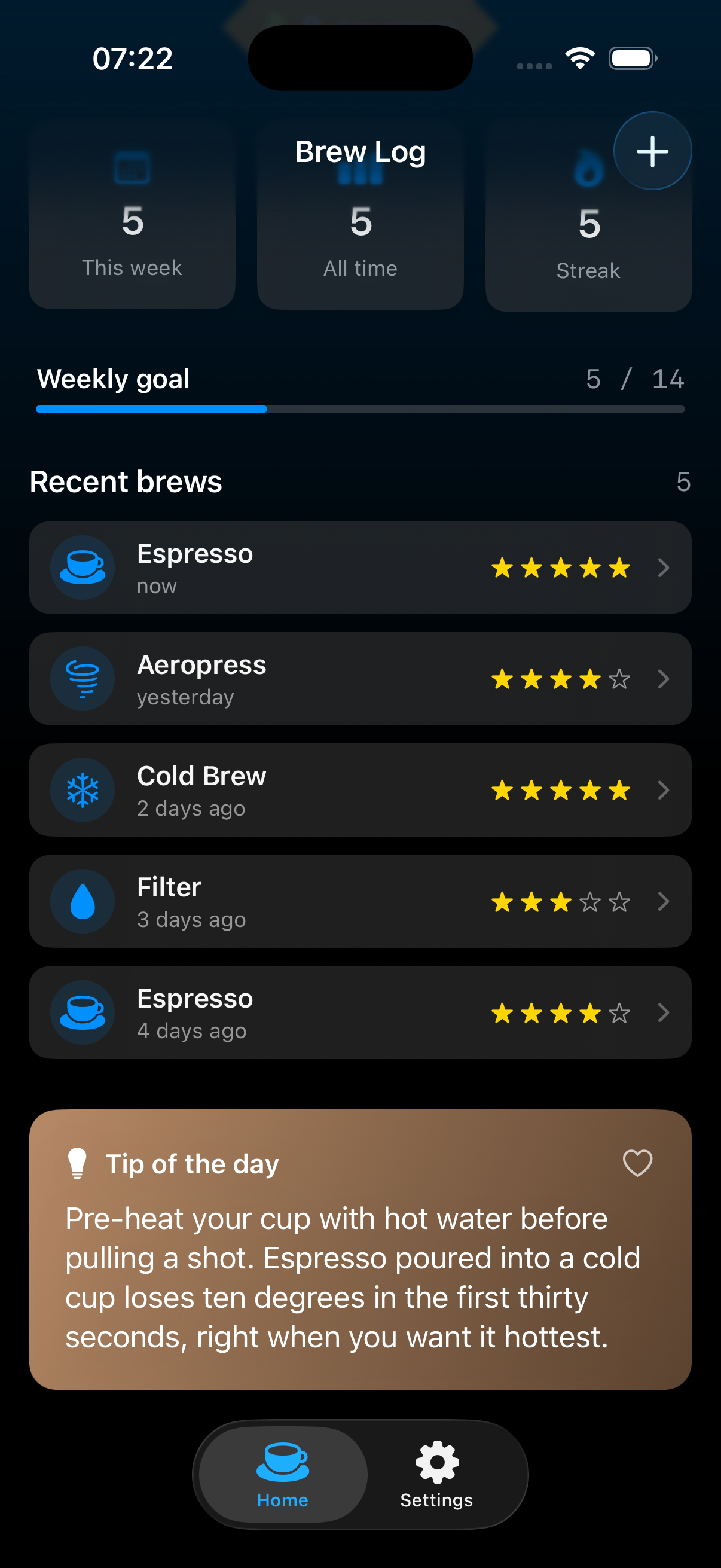
That’s a real network round trip on a real simulator, not a screenshot of a mock. Swap 127.0.0.1:8080 for a real API once BrewLog has one, and nothing else in this post changes — the entire point of the NetworkClient protocol is that the call sites never know the difference.
What’s deliberately not here yet
This is part 1 of 2 on purpose. What’s missing — and what every “build your own networking layer” tutorial conveniently skips — is everything that makes a networking layer survive contact with production: retrying a flaky request, refreshing an expired auth token mid-flight, and not firing the same request five times because five views asked for the same data at once. All three need an actor, because they all involve state that has to stay correct under concurrent access, and that’s exactly the kind of place @MainActor-by-default from Day 1 won’t save you — this state isn’t UI state.
That’s Day 23.
The short version
| Piece | Lines | Job |
|---|---|---|
Endpoint | 7 | Describes a request |
APIError | part of NetworkClient.swift | One typed vocabulary for everything that can go wrong |
URLSessionNetworkClient | ~50 | Sends the request, decodes the response |
BrewTipsService | 18 | The one feature-specific call site |
85 lines, four tests, zero third-party dependencies, and a .serialized trait that exists because the test harness, not the client, had the bug. If you want this kind of test-first discipline baked into a real app’s architecture from line one — composition root, DI, the works — that’s the spine of the SwiftUI at Scale course, built around Atlas from the very first commit instead of retrofitted in on Day 22.
Day 22 of the 30-day iOS development series. Yesterday: TDD for SwiftUI, the non-academic version. Tomorrow: retry, token refresh, and request deduplication in the same networking layer — the production use cases tutorials skip.
Share this post
Comments
Leave a comment
Mario
Founder & CEOFounder of NativeFirst. Building native Apple apps with SwiftUI and a passion for great user experiences.