
10,000 AI Prompts Later, She Forgot How to Code
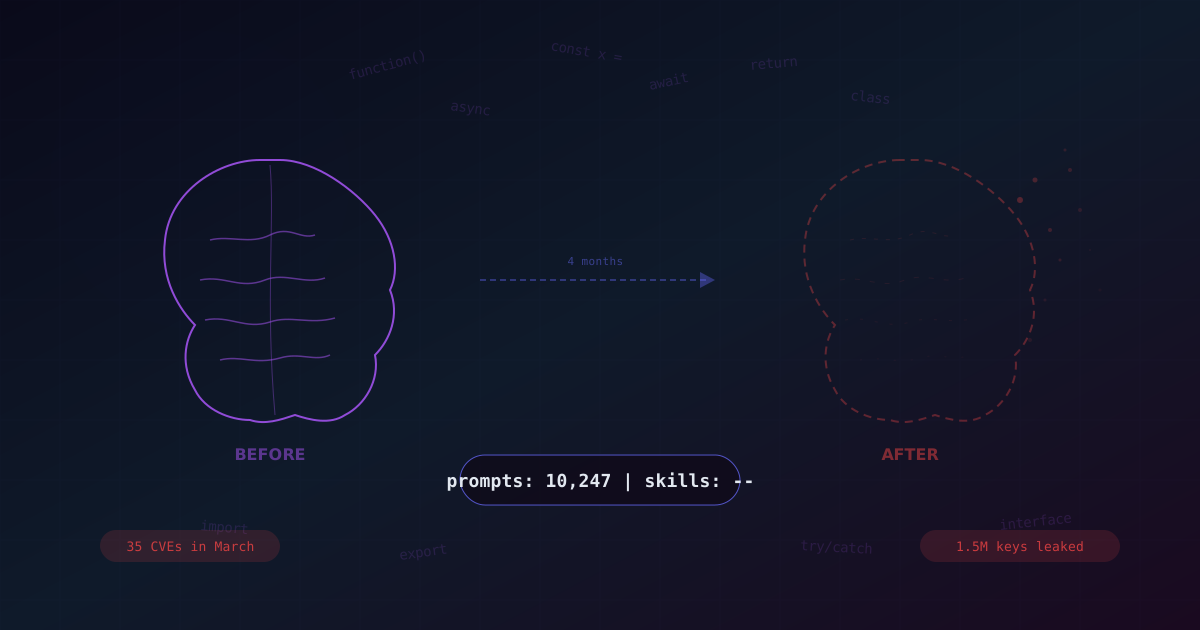
Remember the humans in WALL-E?
They’d been sitting in hovering recliners for so long that their bones had literally atrophied. Robots handled everything — walking, thinking, choosing lunch. The humans didn’t even realize they’d lost the ability to stand up until someone asked them to try.
I keep thinking about that movie. Because right now, something eerily similar is happening to software developers.
”I Started to Lose My Ability to Code”
Pia Torain is a software engineer. Not a hobbyist. Not someone doing her first tutorial. A professional developer at a real company with real users and real production systems.
She spent four months issuing hundreds of AI prompts per day — letting Copilot, Cursor, and ChatGPT handle the heavy lifting while she focused on “higher-level thinking.” Sounds productive, right?
Then one day, she tried to write a function from scratch.
She couldn’t.
Not “couldn’t write elegant code.” Couldn’t write code at all. The patterns she used to know by heart — gone. The mental model of how her codebase fit together — fuzzy. The muscle memory of fingers knowing where to go next — vanished.
Four months. That’s all it took.
When The New Stack interviewed 70+ developers at Google, Amazon, Microsoft, and various startups, Torain wasn’t an outlier. She was just the one honest enough to say it out loud.
The Numbers Behind the Numbness
Here’s what the data says about our collective slide into the WALL-E recliner:
40-60% of AI-generated code gets accepted with minimal or no modification. That’s from GitHub and JetBrains research. Developers aren’t reviewing. They’re rubber-stamping.
Code co-authored with generative AI contains 1.7x more major issues than code written by humans. Security vulnerabilities? 2.74x higher in AI-generated code.
In March 2026 alone, 35 CVEs were directly attributed to AI-generated code. That’s up from 6 in January. The trend line looks like a hockey stick, and not the fun kind.
But here’s the stat that really stings: 66% of developers say their top frustration is dealing with AI solutions that are “almost right, but not quite.”
Almost right. That phrase should be printed on a warning label and slapped on every AI coding tool’s loading screen.
The Moltbook Disaster — A Cautionary Tale for the Ages
If you want to see what “almost right” looks like at scale, meet Moltbook.
Moltbook was a social networking site built entirely through vibe coding. The founder publicly bragged about not writing a single line of code. Everything was AI-generated. Ship fast, break things, disrupt the incumbents — the usual Silicon Valley script.
Then 1.5 million API keys leaked.
The cause? A misconfigured database with public read/write access. Not some sophisticated nation-state hack. Not a zero-day exploit. Just… the database was open. Like a bank vault with the door propped open by a folding chair.
The founder had never written database configuration code. Had never learned what “public read/write” actually means in a production context. Had never developed the instinct that makes an experienced developer’s eye twitch when they see open permissions on anything touching user data.
The AI generated code that worked. It just didn’t generate the understanding of why certain configurations are dangerous. There’s no prompt for intuition.
The Muscle You Don’t Use
There’s a medical term for what happens when you stop using a muscle: atrophy. The fibers shrink. The neural connections weaken. Eventually, the body stops maintaining tissue it considers unnecessary.
Coding is a cognitive muscle. And we’re watching it atrophy in real time.
I’m not being dramatic. Ask any developer who’s been leaning heavily on AI tools for the past year to solve a moderately complex problem with a blank editor and no autocomplete. Time them. Watch their face. That moment of panic when the blinking cursor just sits there, waiting — that’s atrophy.
The brain fry phenomenon was the first symptom. Developers feeling mentally exhausted from constant context-switching between their own thinking and AI suggestions. But deskilling is the next stage. Brain fry was the headache. Deskilling is the muscle wasting away underneath.
The GPS Problem
Here’s an analogy that makes this crystal clear.
Twenty years ago, London taxi drivers had to pass something called “The Knowledge” — memorizing 25,000 streets and thousands of landmarks. Neuroscientists studied these drivers and found their hippocampi (the brain’s spatial memory center) were physically larger than average.
Today? Nobody can navigate anywhere without a blue dot on a screen. Studies show that GPS users have measurably worse spatial memory than people who navigate manually. The brain stopped maintaining neural pathways it no longer needed.
AI coding tools are GPS for your programming brain. Every time you accept a suggestion without understanding it, every time you prompt-and-paste instead of think-and-type, you’re telling your brain: “Don’t bother maintaining that skill. The machine handles it now.”
And your brain listens. It always listens.
The difference is that getting lost in London is an inconvenience. Shipping code you don’t understand is a liability. Just ask Moltbook’s 1.5 million users whose API keys are floating around the internet.
The Reddit Civil War
The developer community is deeply divided on this, and honestly, both sides make points worth hearing.
Camp A — “Good riddance to memorization.” These developers argue that nobody mourns the loss of assembly language fluency. Tools evolve. People should evolve with them. Spending time memorizing syntax when AI can handle it is like refusing to use a calculator because you want to “stay sharp” at long division.
Camp B — “You’re not using a calculator. You’re forgetting math.” This camp points out that a calculator doesn’t work if you don’t understand what to calculate. AI coding tools create an illusion of competence. You can produce code without understanding code, and those are very different things.
The most upvoted comment on one of these threads: “AI will fix one thing but destroy 10 other things in your code.”
That sentence hits different when you’re thinking about 35 CVEs in a single month.
The Uncomfortable Middle Ground
Here’s what we actually think, and it’s annoyingly nuanced: AI coding tools are genuinely useful. We use them. They’re great for boilerplate, exploration, refactoring patterns, and getting unstuck on problems you’ve been staring at for too long.
But there’s a difference between using a power tool and forgetting how to use your hands.
The developers who thrive in the next five years won’t be the ones who prompt the fastest. They’ll be the ones who still understand what the code does after the AI writes it. Who can look at a database configuration and feel that instinct — the one that says “something is wrong here” before any tool flags it.
The vibe coding hangover is already hitting startups who shipped fast and are now drowning in unmaintainable code. The junior developer crisis is creating a generation that never built the fundamentals. And the AI productivity paradox keeps showing us that “moving faster” doesn’t always mean “moving forward.”
The pattern is clear. We’re trading depth for speed. And the invoice for that trade is coming due.
What Smart Developers Are Doing About It
We’re not going to tell you to delete Copilot. That would be stupid and hypocritical.
But here’s what the developers who are taking this seriously have started doing:
Deliberate coding practice. Once a week, turn off all AI assistance and build something from scratch. It’s like going to the gym — you don’t need to deadlift every day, but you need to deadlift sometimes or your body forgets how.
Read before you accept. If you can’t explain every line of an AI-generated suggestion to a junior developer, you don’t understand it well enough to ship it. Period.
Review like it was written by a confident intern. Because that’s basically what it is. AI writes code like someone who read every tutorial ever published but never once maintained a production system at 3 AM when the pager goes off.
Learn the “why,” not just the “what.” When AI generates a database configuration, understand what each setting does. Especially the ones related to access control. Especially those.
The humans in WALL-E eventually learned to walk again. But it took a full-blown crisis to get them out of the chair.
We’re in the middle of ours. The question is whether we’ll get up before or after the next 1.5 million API keys hit the open internet.
Related Reading
- They Called It ‘Brain Fry’ — The AI Burnout Nobody Warned You About — The first symptom of the deskilling crisis
- The Vibe Coding Hangover Has Begun — What happens when AI-built startups hit the maintenance wall
- We Stopped Hiring Juniors — The generation that never learned to code without AI
- The AI Productivity Paradox Nobody Talks About — When moving faster doesn’t mean moving forward
Share this post
Comments
Leave a comment
NativeFirst Team
EditorialThe NativeFirst team — engineers and designers building native Apple apps and writing the courses we wish we had when we started.