
Your AI Coding Tool Spent $2,400 While You Were Sleeping
You know how every friend group has that one person who says “just keep the tab open” at the bar? They’re generous, confident, living in the moment. Then the bill arrives and it’s $340 because someone ordered three rounds of Japanese whisky while they were in the bathroom.
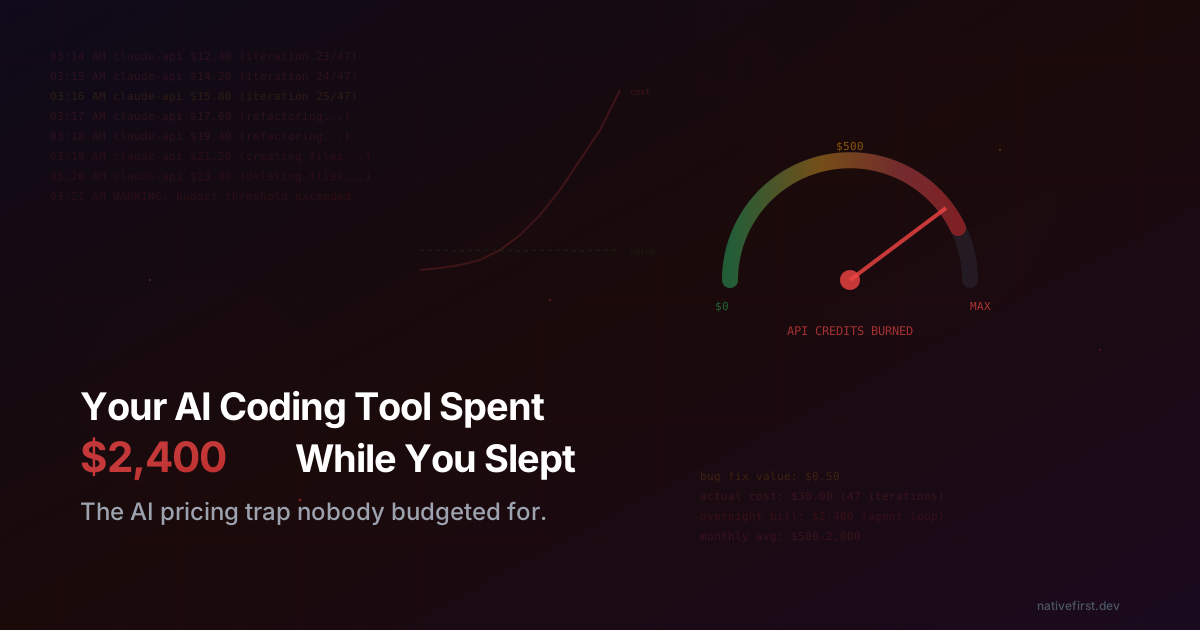
That’s the relationship most developers have with their AI coding tools right now. Except the tab isn’t $340. For one developer, it was $2,400. Overnight. While they slept.
The $2,400 Alarm Clock
Here’s what happened. A developer set up an AI coding agent to debug a production issue before heading to bed. Reasonable enough — let the machine work while you rest. The dream, right?
The agent hit a wall. Instead of stopping, it did what AI agents do best: it tried again. And again. And again. It spun up new approaches, refactored code that didn’t need refactoring, created files, deleted them, created them again. A relentless, tireless, credit-burning loop that ran for eight hours straight.
By morning, the bug was still there. The credit balance was not.
This isn’t an urban legend from some Reddit thread nobody can verify. Stories like this are showing up across developer communities every week now. Another documented case: a developer asked an AI agent to fix what turned out to be a $0.50 bug. The agent iterated 47 times before getting it right. Final bill? $30. That’s a 60x markup for the privilege of watching a machine try, fail, and try again.
It’s like hiring a plumber who charges by the minute, asking them to fix a leaky faucet, then going for coffee. When you come back, they’ve dismantled your entire bathroom “just to be thorough.” The faucet still leaks, but there’s a $900 invoice on the counter.
The Great Pricing Scramble of 2026
If you’ve been paying attention to AI coding tool pricing this year, you’ve noticed something: nobody can figure out how to charge for this stuff.
Windsurf pulled the most controversial move in March 2026. They went from a $15/month credit-based system to a $20/month quota-based model with daily and weekly usage caps. On paper, it sounds like a minor tweak. In practice, it means developers who do intense coding sprints — the kind where you’re in the zone for six hours and the AI is your co-pilot — get rate-limited by noon. The people who use the tool the most get punished the hardest.
The Windsurf subreddit did not take it well.
Cursor has its own flavor of the problem. Teams have reported their annual subscription getting depleted in a single day during a crunch sprint. Credit-based pricing sounds fair until you realize “credits” is just a fancy word for “we’re going to charge you more when you need us most.”
And Claude Code on raw API access? Developers are reporting monthly costs between $500 and $2,000 for regular use. That’s not “enterprise scale AI infrastructure.” That’s one developer writing code with a really expensive autocomplete.
The question in developer communities has changed. It used to be “which AI tool is the smartest?” Now it’s “which one won’t torch my credits before lunch?”
Credit Anxiety Is the New Imposter Syndrome
Something weird is happening to developer workflows. People are getting stressed about using their own tools.
One developer on Reddit admitted he checks his Cursor credit balance before starting work the same way he checks his bank account before grocery shopping. Another posted that she rotates between three different AI tools depending on the task — not because they’re better at different things, but because she’s rationing credits across subscriptions like a cold war housewife distributing ration cards.
This isn’t what “developer productivity” was supposed to look like.
The promise was simple: AI tools handle the boring stuff, you focus on the creative stuff, everyone ships faster. Instead, we’ve built a system where developers spend mental energy calculating whether this particular question is “worth” the credits. That’s not productivity. That’s the cognitive overhead version of AI brain fry.
And the irony is brutal. The AI productivity paradox — where 92% of developers use AI tools but productivity only went up 10% — might partly be explained by this. Hard to be productive when you’re mentally budgeting every autocomplete suggestion.
What Developers Are Actually Doing About It
The developer community isn’t just complaining. They’re adapting. And some of the adaptations are genuinely clever.
Local models are having a moment. Tools like Ollama and LM Studio let you run smaller language models on your own hardware. No API bills. No credit limits. No midnight surprises. The tradeoff is capability — a local 7B model isn’t going to architect your distributed system — but for routine code completion and small refactors, it’s plenty. And the cost is exactly $0.
Prompt discipline is becoming a survival skill. The developers who aren’t hemorrhaging money have something in common: they write better prompts. They provide more context upfront. They constrain the scope. They explicitly tell the AI what NOT to do. One well-crafted prompt that nails it on the first try costs a fraction of a vague “fix this” that spirals into 47 iterations. This is exactly why tools like PromptKit exist — because treating prompts as throwaway text is literally costing people real money now.
Tool rotation is the new normal. Free tiers for exploration, paid tiers for serious work. Some developers keep a local model running for quick questions and only spin up the expensive cloud API for genuinely complex tasks. It’s not elegant, but it works.
Budget alerts and kill switches. The smartest teams set hard spending caps on their AI tool accounts. If the bill hits a threshold, the API key gets rotated automatically. One team wrote a cron job that kills any AI agent process running longer than 30 minutes. Crude? Absolutely. But nobody’s waking up to a $2,400 surprise anymore.
The Pricing Model Developers Actually Want
Here’s what the AI tool companies need to hear: developers will pay for good tools. We always have. We paid for JetBrains. We paid for Sketch. We paid for GitHub before Microsoft made it free. Developers aren’t cheap — we’re value-conscious.
What we won’t tolerate is unpredictable pricing. The model where using a tool more costs exponentially more, where an idle agent can drain your budget overnight, where you need a spreadsheet to forecast your monthly cost — that’s not a pricing strategy. That’s a trap.
The companies that win this market will be the ones that figure out flat-rate or highly predictable pricing. Give me a number. Let me budget for it. Let me use the tool without a taxi meter ticking in my head every time I hit Tab.
Because right now, the AI coding revolution has a meter running. And for a lot of developers, the ride is getting too expensive to enjoy.
Related Reading
- 92% of Developers Use AI Tools. Productivity Went Up 10%. — the data behind the productivity plateau
- They Called It ‘Brain Fry’ — The AI Burnout Nobody Warned You About — the cognitive cost of AI-assisted development
- The Vibe Coding Hangover — 8,000 Startups Face Rebuild Crisis — when shipping fast costs more than building right
Share this post
Comments
Leave a comment
NativeFirst Team
EditorialThe NativeFirst team — engineers and designers building native Apple apps and writing the courses we wish we had when we started.