How ATS Systems Actually Work — And How ApplyIQ Beats Them
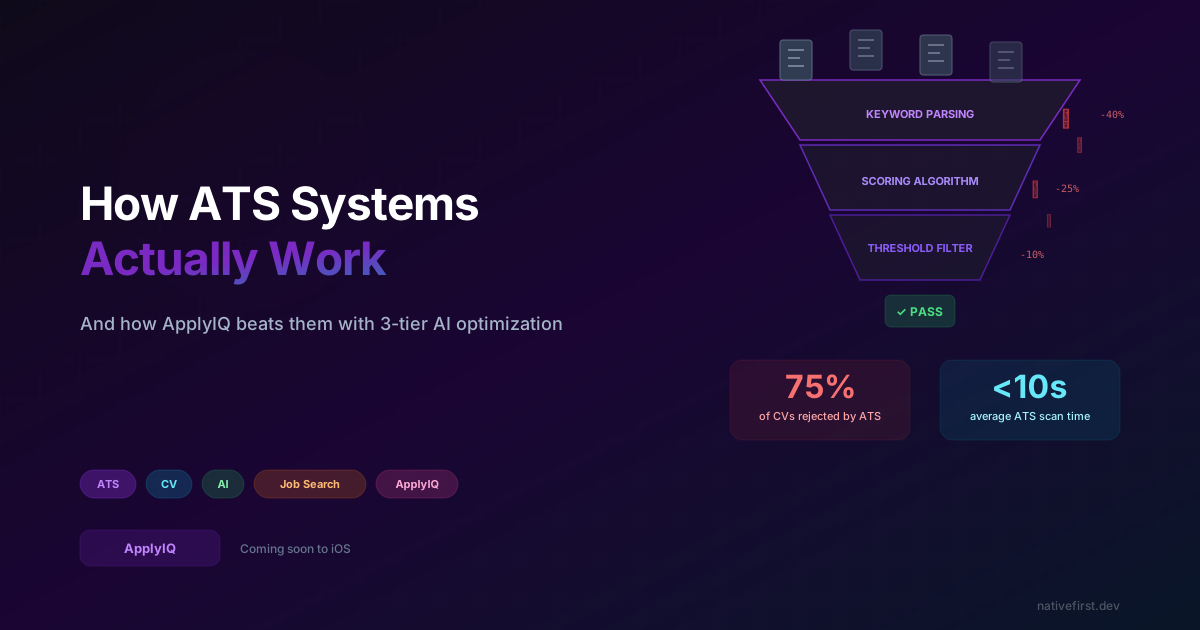
You spend an hour tailoring your CV. You write a strong cover letter. You hit apply. And then… nothing. No rejection email. No interview. Just silence.
This is the reality for roughly 75% of all job applications today. Your CV never reaches a human. It gets filtered out by an Applicant Tracking System — a piece of software that decides in seconds whether your application moves forward or disappears into a digital void.
We built ApplyIQ because this problem is solvable. But to understand the solution, you first need to understand the problem.
What Is an ATS?
An Applicant Tracking System is software that companies use to manage their hiring pipeline. Think of it as the front door to every job application. Before a recruiter or hiring manager sees your CV, the ATS processes it first.
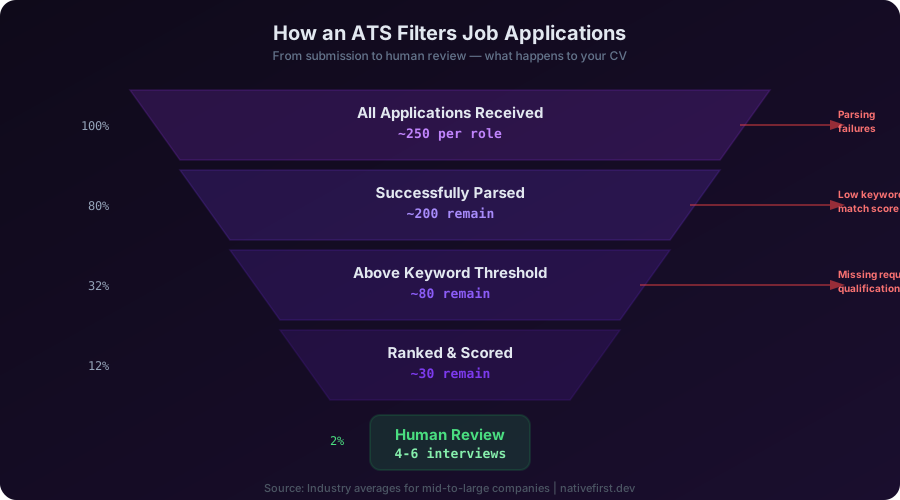
The biggest names in the ATS market are Workday, Greenhouse, Lever, iCIMS, Taleo (Oracle), and SAP SuccessFactors. If you have applied to a company with more than 50 employees in the last five years, your application almost certainly went through one of these systems.
Here is the critical thing most applicants do not understand: an ATS is not just a database. It is a filtering engine. It parses your CV, extracts structured data, scores it against the job description, and ranks you against every other applicant. If your score is too low, your application is automatically deprioritized or rejected — no human involved.
How ATS Parsing Actually Works
When you upload your CV, the ATS runs it through a parser. This parser attempts to extract:
- Contact information — name, email, phone, location
- Work experience — job titles, company names, dates, descriptions
- Education — degrees, institutions, graduation dates
- Skills — both explicitly listed and inferred from context
- Certifications — professional qualifications
- Keywords — terms that match the job description
The parser converts your beautifully formatted PDF into raw structured data. And this is where the first problems begin.
The Formatting Trap
Most ATS parsers struggle with:
- Tables and columns — Two-column layouts confuse parsers. They read left-to-right, top-to-bottom, which means your skills section on the left gets merged with your experience dates on the right.
- Headers and footers — Content in headers or footers is often ignored entirely.
- Images and icons — That sleek skill-level bar chart? Invisible to the ATS. Those contact info icons? The ATS sees nothing.
- Custom fonts — Some fonts cause character mapping issues, turning your text into garbled data.
- PDF text layers — If your PDF was exported from a design tool without proper text layers, the ATS may see a blank document.
This means a CV that looks stunning to a human can be completely unreadable to a machine. The irony is painful: the more effort you put into visual design, the more likely you are to fail the automated screening.
The Keyword Matching Algorithm
Once parsed, your CV goes through keyword matching. This is where most applications die.
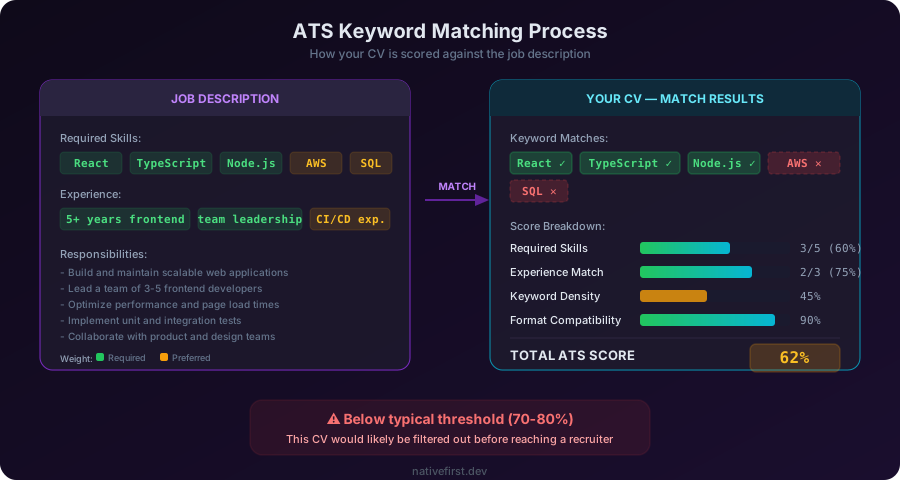
The ATS compares the content of your CV against the job description and generates a match score. Different systems calculate this differently, but the core logic is similar:
1. Exact Keyword Matching
The most basic level. If the job description says “React” and your CV says “React”, that is a match. If your CV says “ReactJS” or “React.js”, some systems catch it, others do not. If your CV says “I built user interfaces using modern JavaScript frameworks” without ever mentioning React by name, most systems score it as zero for that keyword.
2. Semantic Matching
More advanced ATS systems (Workday, Greenhouse) use natural language processing to understand synonyms and related terms. “Project management” might match with “program management”. “Full-stack developer” might partially match “frontend engineer”. But this matching is imperfect and inconsistent across systems.
3. Weighted Scoring
Not all keywords are equal. Job titles and required skills are weighted more heavily than nice-to-have qualifications. A keyword appearing in your job title carries more weight than the same keyword buried in a bullet point. Recent experience is weighted more than old experience.
4. Frequency Analysis
Some systems look at how many times relevant keywords appear. One mention of “Python” is a signal. Three mentions across different roles is a pattern. But keyword stuffing — repeating “Python” twenty times — triggers spam filters. The balance matters.
The Result
After this analysis, the ATS assigns your application a score — often expressed as a percentage. A typical cutoff is 60-80%. Below the threshold, your application is automatically moved to the rejected pile. Above it, a human finally gets to see your CV.
The problem? Most applicants have no idea what their score is, what keywords they are missing, or how to improve it. They are playing a game without knowing the rules.
Why Most CVs Fail
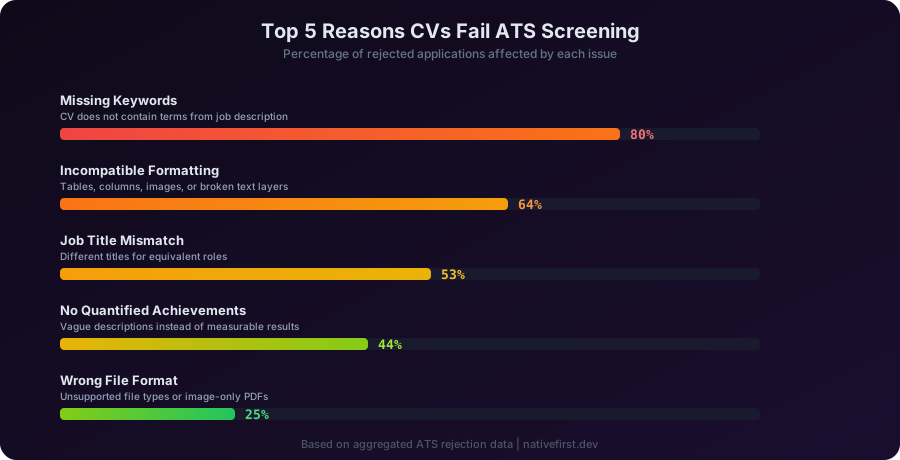
Based on industry data and our research building ApplyIQ, here are the most common reasons applications get filtered out:
1. Missing keywords. The number one reason. Your CV simply does not contain the terms the ATS is looking for. You might be perfectly qualified, but if you describe your experience differently than the job description does, the system does not make the connection.
2. Wrong file format. Some ATS systems handle .docx better than .pdf, and vice versa. A few still struggle with anything other than plain text. The safest formats are .docx and well-structured .pdf with proper text layers.
3. Incompatible formatting. Tables, columns, graphics, custom layouts — all of these can break parsing. The ATS extracts gibberish, and your score tanks.
4. Lack of quantified achievements. Modern ATS systems are increasingly sophisticated. They look for patterns like “increased revenue by 30%” or “managed a team of 12”. Vague descriptions like “responsible for sales” carry less weight.
5. Job title mismatch. If the role is “Senior Software Engineer” and your CV says “Lead Developer”, some systems treat these as different roles entirely. The experience matches, but the titles do not.
How ApplyIQ Solves This
This is exactly why we built ApplyIQ. We wanted to give job seekers the same visibility into ATS scoring that recruiters have — and then go further by actually optimizing the CV automatically.
The 3-Tier Optimization System
ApplyIQ does not just tell you what is wrong. It rewrites your CV with three levels of ATS optimization, giving you full control over how aggressively the optimization is applied:
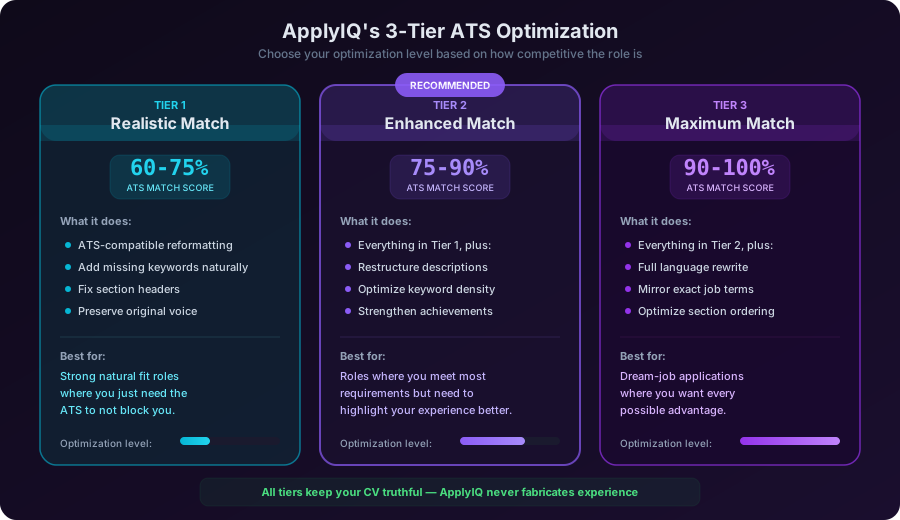
Tier 1 — Realistic Match (60-75% ATS Score)
This is the conservative option. ApplyIQ takes your base CV and makes targeted adjustments: reformatting for ATS compatibility, adding missing keywords where they naturally fit, and ensuring proper section headers. Your CV stays close to what you wrote, but it is now machine-readable and keyword-aligned.
Best for: Applications where you are a strong natural fit and just need to ensure the ATS does not filter you out on a technicality.
Tier 2 — Enhanced Match (75-90% ATS Score)
The middle ground. ApplyIQ restructures your experience descriptions to align with the job description’s language, adds relevant skills you may have omitted, strengthens quantified achievements, and optimizes keyword density. Your CV is noticeably improved but still authentically yours.
Best for: Applications where you meet most requirements but need to highlight your experience more strategically.
Tier 3 — Maximum Match (90-100% ATS Score)
The aggressive option. ApplyIQ fully rewrites your experience to mirror the job description’s exact language, ensures every required keyword appears with proper frequency, optimizes section ordering, and maximizes the match score. Everything remains truthful — ApplyIQ never fabricates experience — but the language is precisely calibrated for the ATS.
Best for: Dream-job applications where you want every possible advantage. Use with the understanding that you should be able to back up every claim in an interview.
How the AI Works
ApplyIQ’s optimization engine works in several steps:
-
Job description analysis — The AI parses the job posting, identifies required skills, preferred qualifications, key responsibilities, and the specific language used.
-
CV parsing — Your base CV is analyzed for existing keywords, experience, skills, and structure.
-
Gap analysis — The AI identifies what is missing: keywords not present, skills not highlighted, achievements not quantified, formatting issues that would break ATS parsing.
-
Intelligent rewriting — Based on your selected tier, the AI rewrites relevant sections to close the gaps. It uses natural language, avoids keyword stuffing, and maintains your authentic voice.
-
Score prediction — ApplyIQ estimates your ATS match score so you can see the improvement before you apply.
All of this happens on your device. Your CV data never leaves your phone.
Beyond the CV: Interview Preparation
Getting past the ATS is only half the battle. The next step is the interview — and most people are woefully underprepared for it.
ApplyIQ includes a full Interview Coach that generates role-specific questions across four categories:
Overview questions — High-level questions about your background and motivation. “Walk me through your resume.” “Why are you interested in this role?”
Common questions — Frequently asked behavioral questions with difficulty ratings. “Tell me about a time you disagreed with your manager.” “How do you handle tight deadlines?”
STAR method questions — Behavioral questions structured around the Situation-Task-Action-Result framework, with color-coded breakdowns to help you structure your answers.
Technical questions — Role-specific technical questions based on the skills listed in the job description.
And then there is the Mock Interview — 15 timed questions, 2 minutes each, simulating a real interview under pressure. You answer in real-time and rate your own performance after each question. It is the closest thing to a real interview you can get without an actual interviewer.
Tips for Beating the ATS Today
Even without ApplyIQ, you can improve your ATS success rate starting now:
1. Mirror the job description’s language. If the posting says “stakeholder management”, use that exact phrase — not “working with stakeholders” or “managing client relationships”.
2. Use standard section headers. “Work Experience” not “My Journey”. “Education” not “Academic Background”. ATS systems look for conventional headers.
3. Keep formatting simple. Single column. Standard fonts (Arial, Calibri, Times New Roman). No tables, no graphics, no icons. Save the creative design for your portfolio.
4. Include a skills section. List your key skills explicitly. Do not assume the ATS will infer them from your experience descriptions.
5. Tailor every application. A generic CV sent to 100 jobs will score lower than a tailored CV sent to 10. The math is simple: 10 applications at 80% match beat 100 applications at 30% match.
6. Use both the acronym and the full term. Write “Search Engine Optimization (SEO)” so the ATS catches both variants.
7. Quantify everything. “Increased user engagement by 45%” beats “improved user engagement” every time, both for ATS scoring and human reviewers.
The Bigger Picture
ATS systems are not going away. If anything, as AI improves, the filtering will become more sophisticated. Companies receive hundreds or thousands of applications for every role, and automated screening is the only way to manage that volume.
The imbalance is clear: companies have powerful tools to filter candidates, but candidates have been left to guess what those tools are looking for. ApplyIQ exists to level that playing field.
Your skills, your experience, your potential — none of that changes. What changes is whether a machine lets a human see it. And that is a problem worth solving.
ApplyIQ is now available on the App Store. Built native, on-device, and privacy-first — because your career data is nobody’s business but yours.
Ready to land your dream job? Download ApplyIQ on the App Store. Have questions or feedback? Get in touch.
Share this post
Comments
Leave a comment
Rachel Torres
Content & ResearchContent strategist at NativeFirst. Researching the intersection of technology, mental health, and user advocacy.