
They Fired 80,000 Developers for AI. Then the AI Needed a Developer.
You know that friend who dumps their partner, posts cryptic quotes on Instagram about “choosing myself,” spends three months on dating apps, and then shows up at the ex’s apartment at midnight with a bottle of wine and a speech about how they “made a mistake”?
That’s corporate America right now. Except instead of a bottle of wine, it’s a LinkedIn recruiter message. And instead of “I made a mistake,” it’s “we have an exciting opportunity that aligns with your previous experience.” The previous experience being the exact job they fired you from.
The Hangover Math
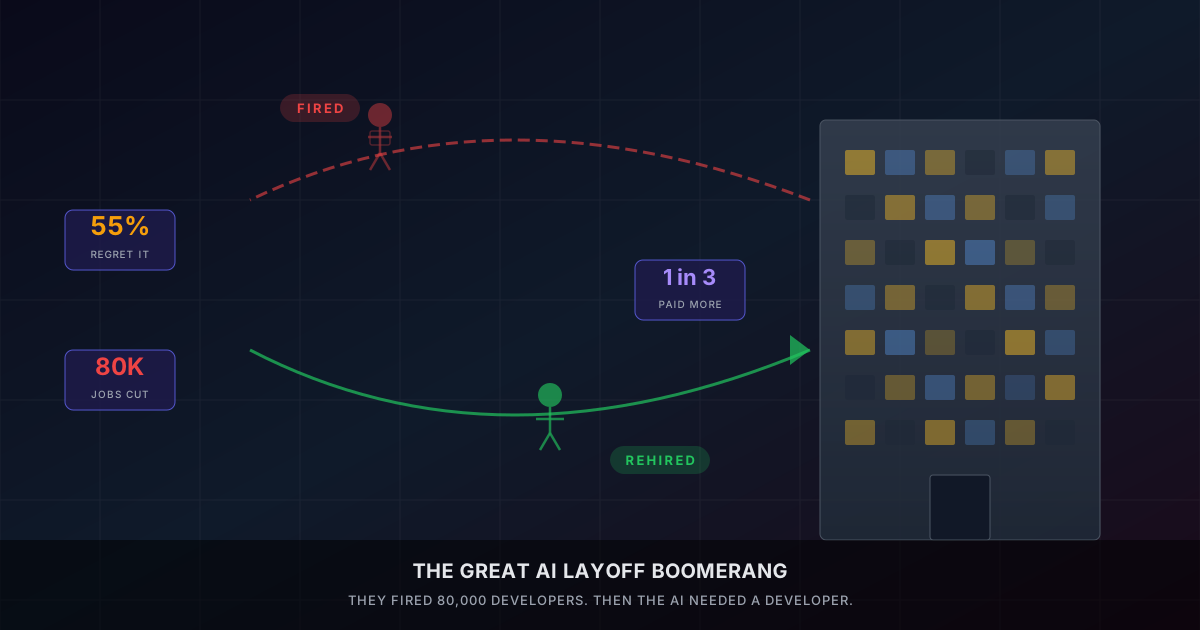
We already covered the layoff wave. Nearly 80,000 tech workers lost their jobs in Q1 2026 alone. Almost half of those cuts were explicitly blamed on AI. Oracle fired 30,000 people via a 6 AM email. Salesforce gutted its support team. Everyone had a slide deck about the AI-powered future.
Cool. So how’s that future looking?
According to Forrester, 55% of companies now regret their AI-driven layoffs. Not “feel slightly bad about.” Regret. As in, they measured the outcome and realized they made it worse.
Here’s the number that should be tattooed on every CFO’s forehead: one in three companies spent more on restaffing than they saved from the layoffs. They paid severance. They lost institutional knowledge. They hemorrhaged senior talent who immediately got hired elsewhere. Then they spent months trying to find replacements — often for the same roles, at higher salaries, with signing bonuses.
It’s like renovating your kitchen by ripping out all the plumbing, realizing you actually need running water, and then paying triple to have it reinstalled. Except the plumber you fired now charges consultant rates.
The Klarna Cinematic Universe Continues
If you’ve been following the Klarna saga, you already know the first act. CEO goes on a victory tour in 2024: AI replaced 700 customer service agents. Costs are down. The future is automated.
The second act was quieter. Customer satisfaction scores cratered. The AI handled volume but not complexity. Nuance? Empathy? A frustrated customer who just got double-charged and wants to talk to a human? The chatbot responded with the emotional intelligence of a parking meter.
By mid-2025, Klarna was quietly posting job listings for human customer service agents. By early 2026, the CEO himself admitted that cost had been “a too predominant evaluation factor.” Translation: we looked at a spreadsheet and forgot that customers are people.
But here’s the twist nobody talks about. Klarna isn’t rehiring those 700 people into full-time roles with benefits. Reports suggest they’re considering an Uber-style gig model — bringing in remote workers to handle customer service from home, with less stability and lower pay than the original employees had.
So the timeline is: fire people, replace with AI, AI fails, rehire people, but worse.
It’s a downgrade disguised as innovation.
Meanwhile, IBM Did the Opposite
While most of tech was busy making dramatic AI-replacement announcements, IBM went the other way.
In February 2026, IBM announced it would triple entry-level hiring in the US. That includes software developers — the very role everyone else was cutting.
The reasoning? IBM’s HR chief said that the companies winning in 2031 will be the ones that doubled down on hiring now. Cut your junior pipeline today, and in five years you have no mid-level engineers, no future leaders, and a dependency on external hiring that costs 3x more.
It’s one of those moves that looks boring in a headline but is actually the smartest play in the room. While Oracle fires 30,000 people for a data center bet and Salesforce guts its support team for a chatbot, IBM is quietly building the bench.
The same week, CNN ran an article titled “The demise of software engineering jobs has been greatly exaggerated.” Job listings for software engineers on Indeed are up 11% year over year. Companies are expanding software budgets. The University of Washington’s CS department head wrote to panicking students: AI isn’t killing your career. It’s expanding it.
The Numbers Don’t Lie (But the Press Releases Do)
Let’s put some data behind the boomerang.
Gartner published a prediction in February 2026: by 2027, 50% of companies that attributed layoffs to AI will rehire staff for similar functions — often under different job titles. “Customer Service Agent” becomes “AI Escalation Specialist.” “Software Developer” becomes “AI Systems Supervisor.” Same work. New LinkedIn headline.
The Forrester numbers are even more damning:
- 55% of companies regret AI-driven layoffs
- 35.6% have already rehired more than half the roles they eliminated
- 1 in 3 spent more on restaffing than they saved
- Only 1 in 5 said AI fully replaced the eliminated roles without operational issues
That last stat is the one that matters. Eighty percent of companies that fired people for AI couldn’t actually replace them with AI. They made a bet on technology that didn’t exist yet and lost.
As we wrote before: they didn’t fire you for AI. They fired you for a PowerPoint about AI. Now they’re paying for the sequel.
What Changed (and What Didn’t)
Here’s the thing nobody in the C-suite wants to say out loud: the jobs came back, but the trust didn’t.
When you fire someone, replace them with a chatbot, watch the chatbot fail, and then ask the person to come back at a lower salary with fewer benefits — you don’t get a loyal employee. You get someone who’s already interviewing at your competitor.
A LinkedIn report predicted this exact pattern in their “25 Big Ideas for 2026.” They called it “boomerang hiring” — the wave of layoff regret and subsequent rehiring. But they also noted the catch: the best people won’t come back. They’ve already moved on.
The institutional knowledge is gone. The team dynamics are broken. The remaining employees — the ones who survived the cuts — are burned out from absorbing extra work and watching their colleagues get replaced by algorithms that couldn’t do the job.
This is where the junior developer crisis meets the layoff boomerang. Companies cut juniors because AI could “handle it.” Now they have no pipeline, no mentorship chain, and senior developers who are exhausted and skeptical. The damage compounds.
If You Got Laid Off: This Is Your Leverage
Here’s the uncomfortable reality for companies doing the crawl-back: the market has shifted.
If you’re a developer who got cut in the AI layoff wave, you now have something you didn’t have six months ago — proof that you were needed all along. The company’s own failure to replace you is your strongest negotiating chip.
A few things to keep in mind:
Don’t accept the first offer. If they’re coming back to you, the leverage is yours. The 55% regret rate means they’re desperate, even if the recruiter sounds casual.
The job title might be different. Gartner predicts rehiring under new titles. Don’t get hung up on what it’s called. Look at the actual work and the actual compensation.
Your ATS game matters more than ever. Companies that are rehiring are often doing it through the same automated systems that screen thousands of applicants. If you’re applying cold rather than being recruited back directly, understanding how ATS systems filter you out is the difference between getting seen and getting ghosted. Tools like RoleBud exist because the application pipeline is broken — and the companies doing the rehiring haven’t fixed it.
IBM isn’t the only one hiring. The narrative that “AI killed developer jobs” was always louder than reality. Indeed’s data shows software engineering listings climbing. The companies that never panicked — that treated AI as a tool instead of a replacement — are hiring steadily.
The Pattern Always Repeats
Cloud was supposed to eliminate IT departments. It didn’t — it changed what IT departments do. Mobile was supposed to kill desktop development. It didn’t — it created more work. Every technology cycle follows the same arc: revolutionary claims, mass panic, overcorrection, and then a quiet return to reality where the technology is useful but humans are still necessary.
The AI layoff boomerang is just the latest episode in a very old show.
The companies that will win aren’t the ones that fired 30,000 people for a data center bet. They’re the ones that kept their teams, trained them on AI tools, and used the technology to make good people better instead of making good people unnecessary.
The boomerang always comes back. The question is whether you’re the one catching it, or the one it hits in the face.
Share this post
Comments
Leave a comment
NativeFirst Team
EditorialThe NativeFirst team — engineers and designers building native Apple apps and writing the courses we wish we had when we started.